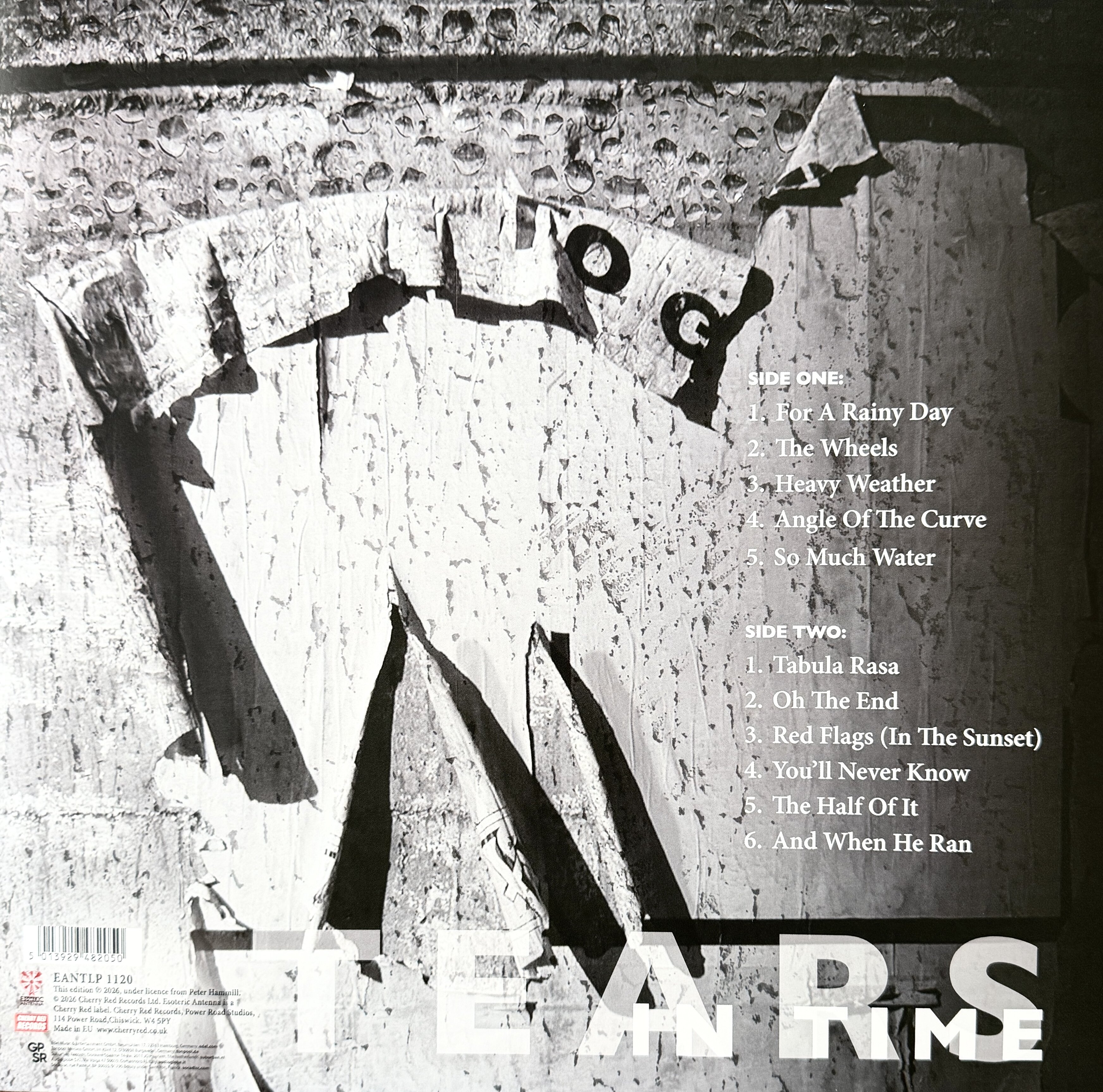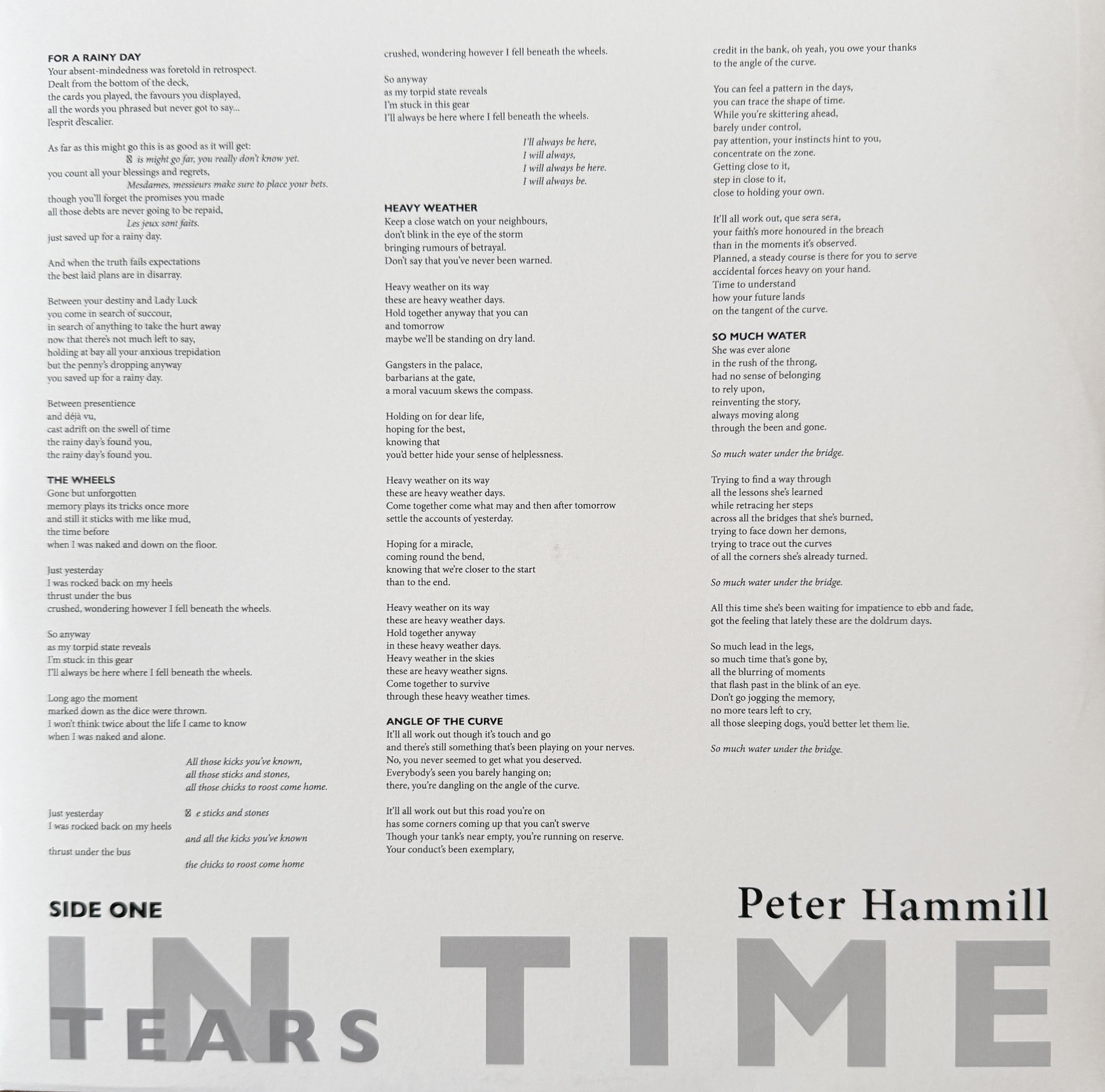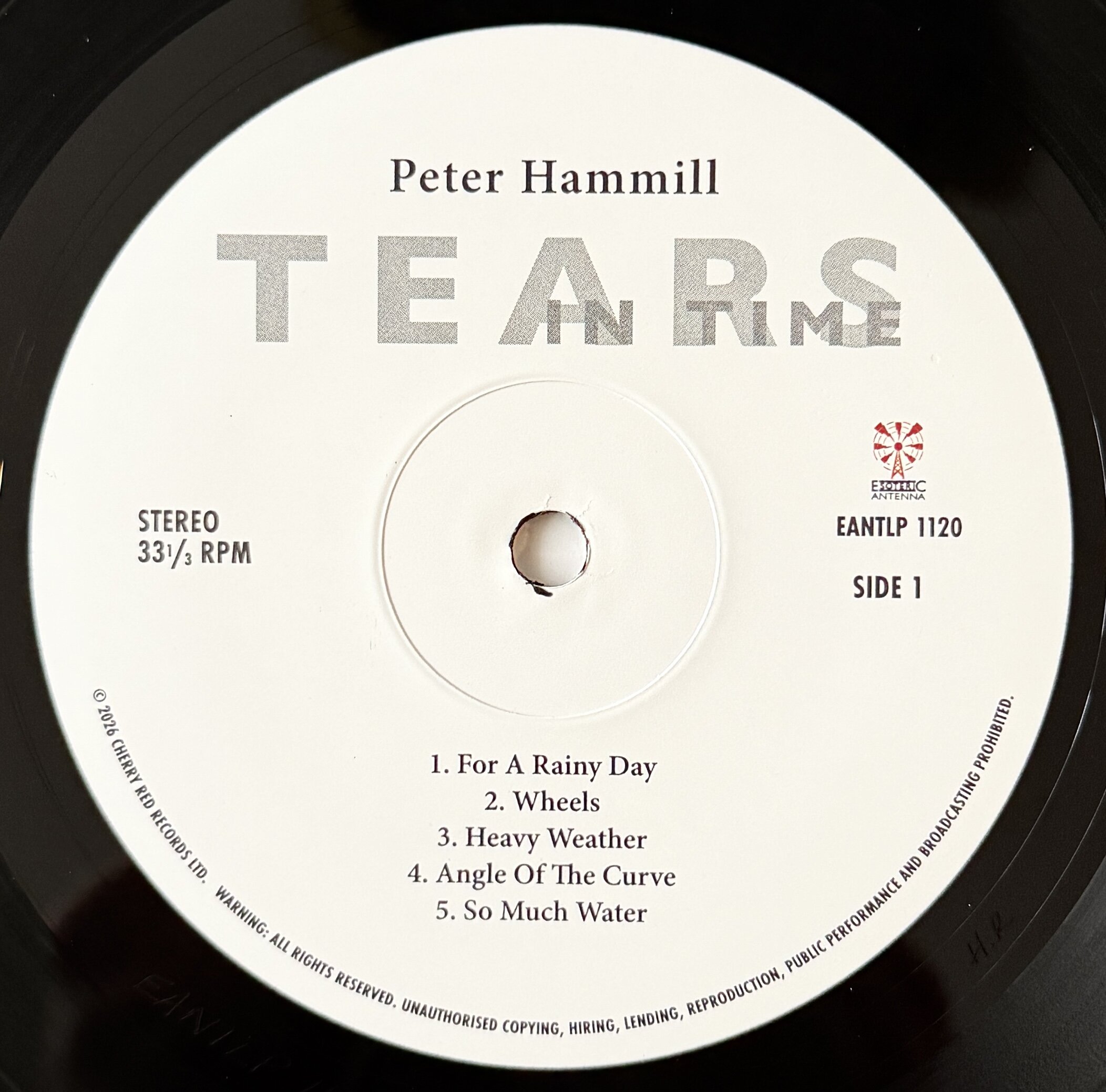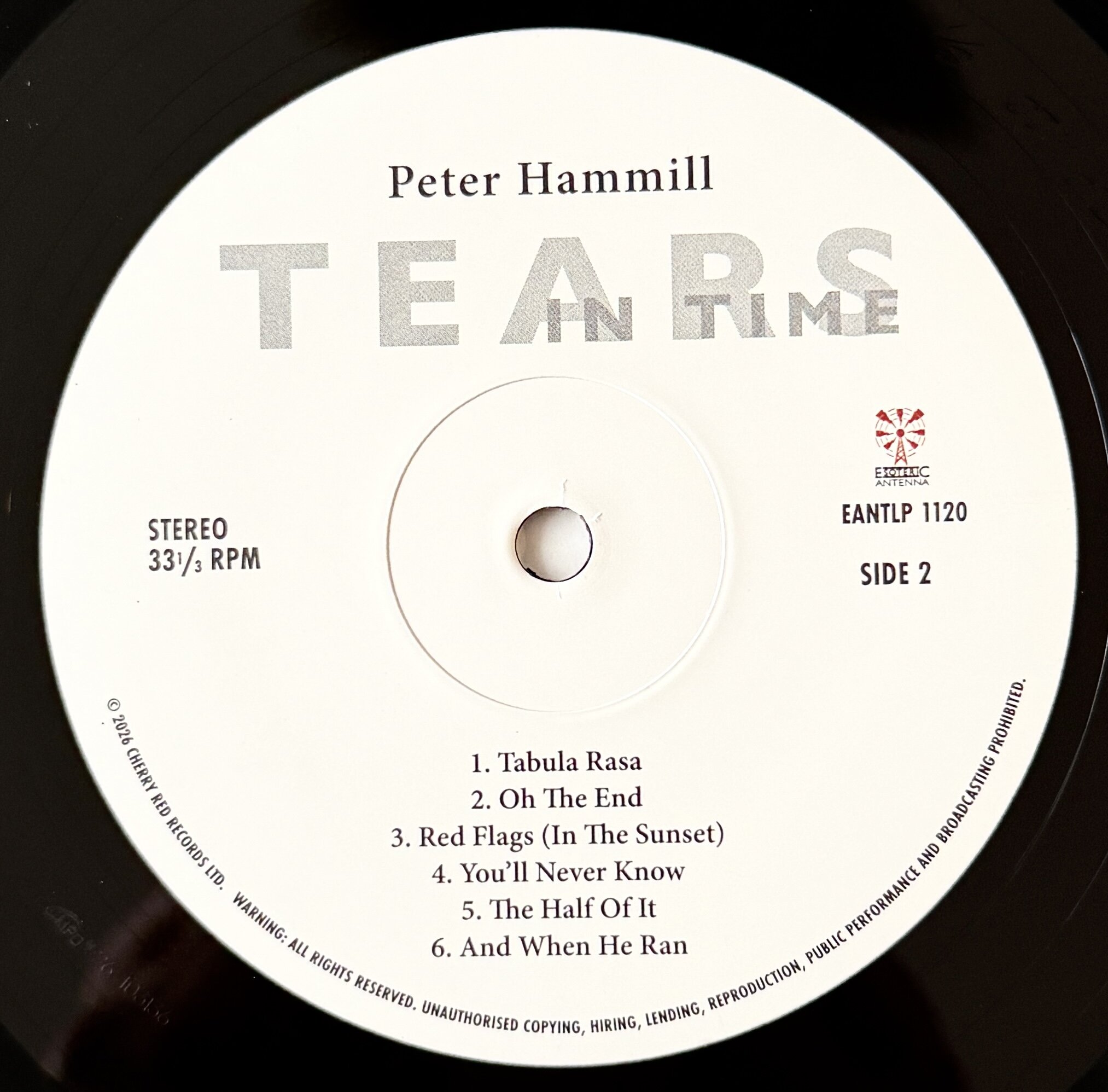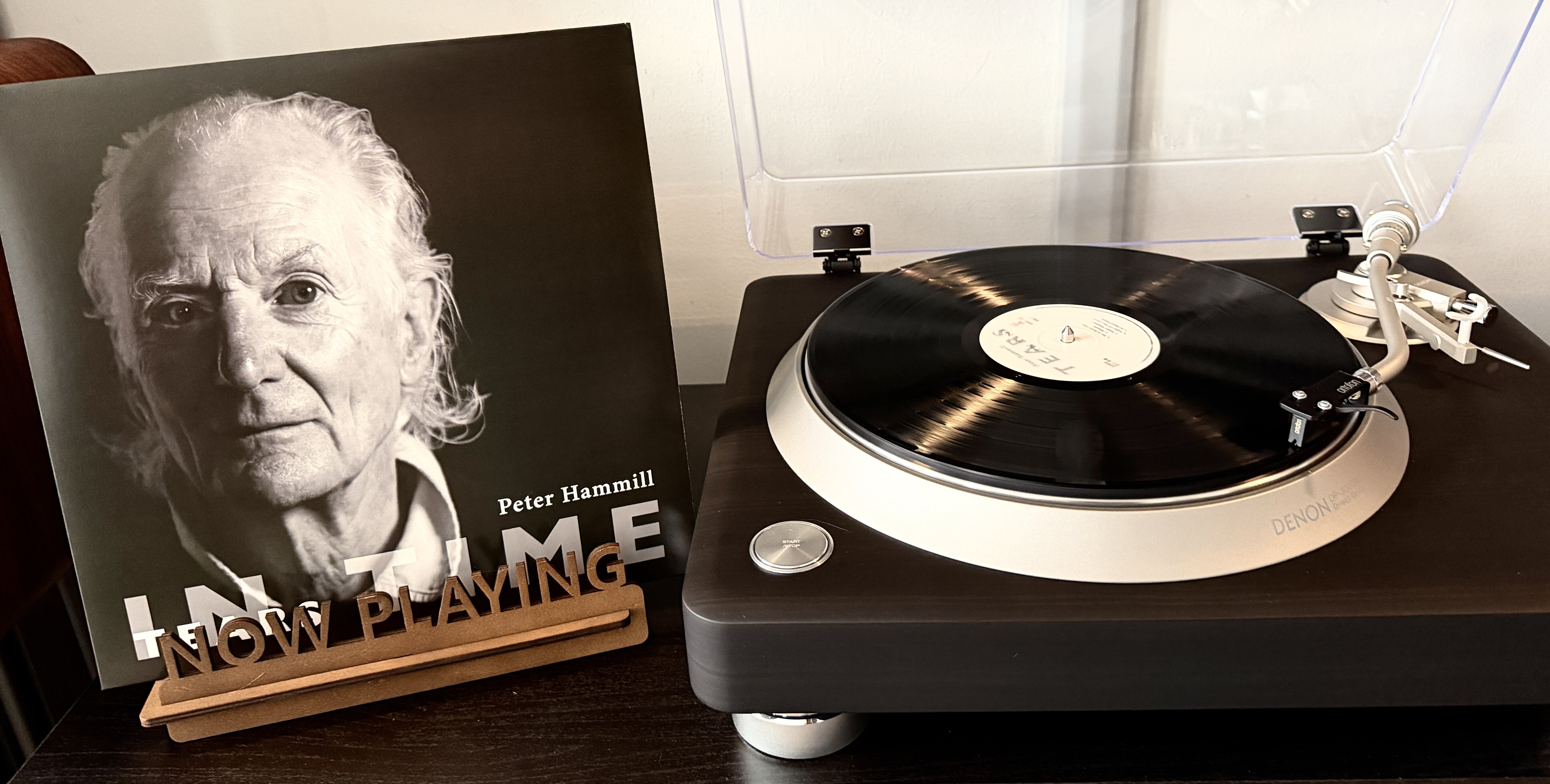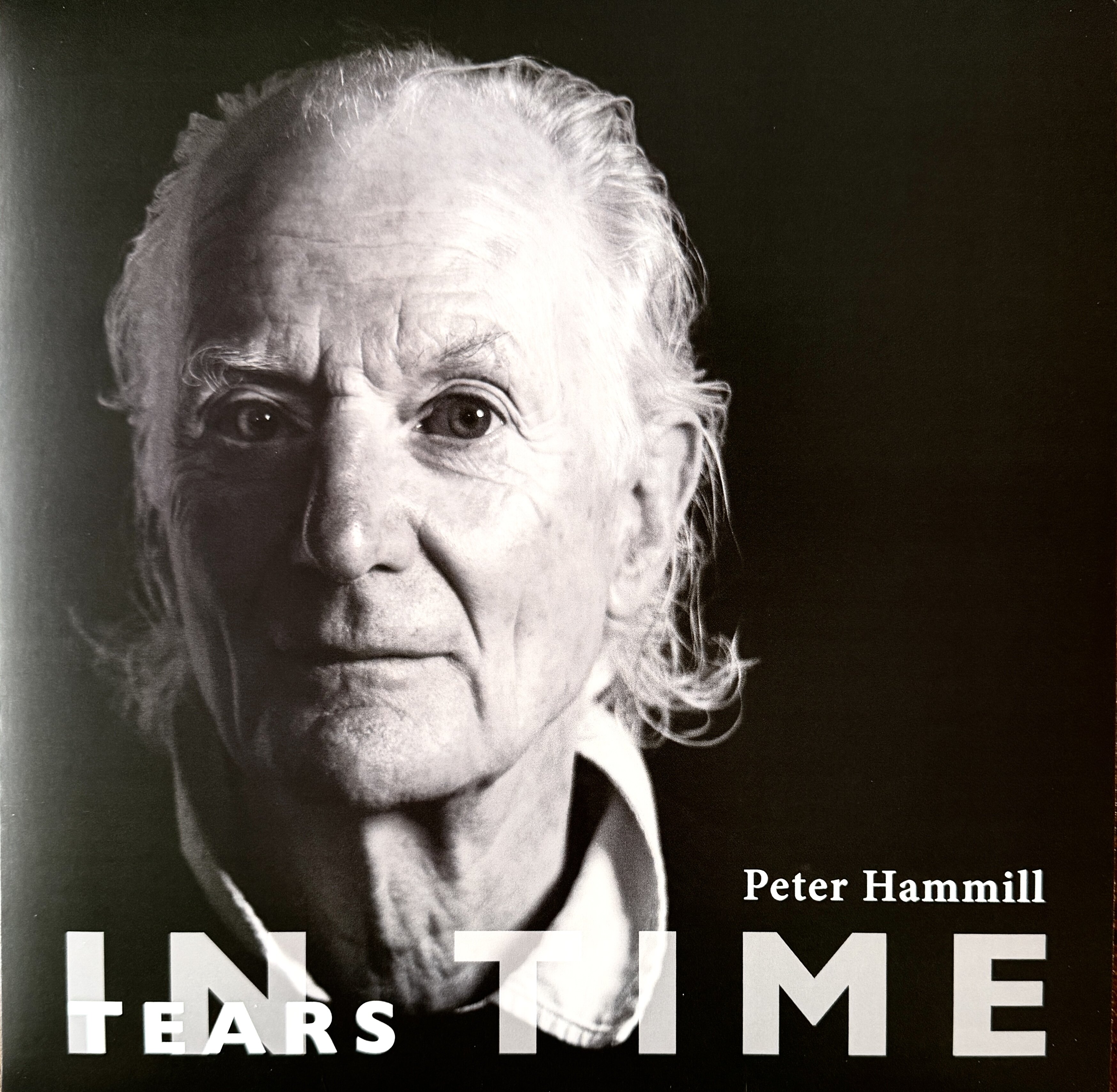
Tears in Time by Peter Hammill, a 2026 album.
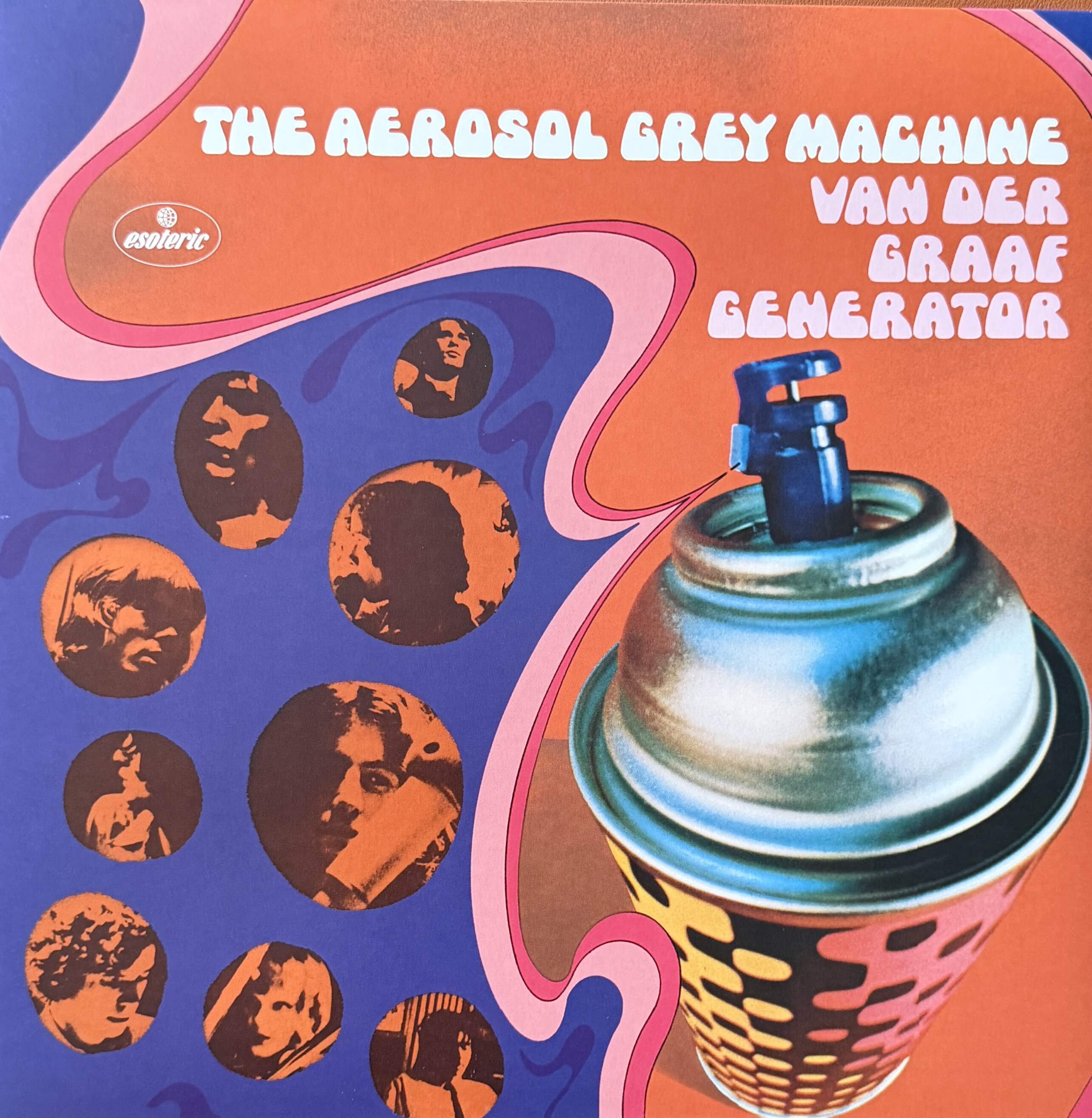
Tears in Time is the new solo studio work by British singer-songwriter Peter Hammill, historic leader and voice of Van der Graaf Generator.
The album consists of 11 songs never released before, born and recorded between 1991 and 2026. Hammill said that, although they were written in different periods and in different styles, at a certain point he felt there was an invisible thread linking them.
Once he found this connection, he went back to the old tapes and reworked them, adding new parts and completing them with his current experience and musical taste. Thus, he created a fluid album, blending past and present. Some songs, like “Heavy Weather” and “Tabula Rasa”, had been born in the ’90s as simple instrumental experiments, and only recently did Hammill decide to finish them by adding lyrics.
On this album Hammill decided to do everything by himself, creating a wholly personal work. In the album credits, the line-up is simply “Peter Hammill / everything” (Peter Hammill / everything), to stress that he recorded it all in his studio, Terra Incognita.
He sang both lead and harmonies, played piano and keyboards (also with synths and orchestral or ambient effects), and played both acoustic and electric guitars. He then recorded bass and drums, incorporating post-punk rhythms and vintage electronic beats. There are no other collaborators.
Tears in Time is an intimate, deep album that takes you into a twilight, bare world, yet one rich in nuances. The fact that Peter Hammill worked on this project in solitude for a full 35 years can be heard in every note, every breath.
Many tracks rest on the two pillars of Hammill’s songwriting: piano and arpeggiated acoustic guitar.
There are essential ballads, almost skeletal, where the voice, fragile yet full of expression, is accompanied by just a few chords. It’s a confessional, theatrical style, typical of his more mature music, that goes straight to the heart.
Alongside the acoustic moments, the album also explores more experimental territory, with art rock, ambient and dark influences. Hammill makes heavy use of keyboard pads, vintage synths and sampled orchestrations. Some tracks have cold, almost ghostly atmospheres, with electronic loops that create a sense of unease.
And then there are the more energetic, jagged moments where Hammill brings out his more rock, edgy soul, with distorted electric guitars, pulsing bass lines and programmed drum rhythms that recall post-punk and industrial.
The common thread through the whole album is Hammill’s voice. Even though the record includes recordings of his voice at fifty in the ’90s and nearly eighty in 2026, his unique style—moving from dramatic whisper to falsetto, to an almost spoken declamation—manages to unite the different eras, creating a continuous and incredibly coherent sonic flow. It’s as if time stops, making it possible to travel through his emotions.
Across the tracks and lyrics emerge the album’s core themes: inevitable mortality, and the passing of time…
“For A Rainy Day” opens the record, immediately setting the overall tone. It starts quietly, with a dramatic air, thanks to a piano that introduces Hammill’s voice with an almost whispered delicacy. Then the string arrangement enters, building a crescendo that, even as it grows, always remains measured and restrained. The lyric invites reflection on melancholy, but without slipping into resignation. It speaks of “saving something for rainy days”, a metaphor that suggests old age and the importance of storing up memories or emotional resources to face life’s hardest moments. A wonderful track—moving, theatrical, and superbly performed—ending on an unsettling note, in his typical style.
“The Wheels” is a hypnotic piece with a musical structure supported by layered keyboards and programmed drums that evoke new wave sounds. The title itself, “The Wheels”, is echoed in the cyclical nature of the composition. The lyric explores the theme of the wheels of time and fate, turning relentlessly, crushing regrets and pushing us to accept the present. A complex composition with a deep rhythmic base and dissonant strings and synths.
“Heavy Weather” is one of the album’s most successful tracks. It has an ’80s synth-pop atmosphere, with cold sonorities created by the keyboards and drum machines of the time, conveying a sense of unease. The lyric uses the metaphor of “weather storms” to represent heavy psychological turbulence, creative crises and the difficulties encountered in life. An electronic approach for a dark, tense sound, yet with a catchy chorus. Hammill’s voice makes the track sharp and powerful, quickly letting the “pop” suffix fall away.
“Angle Of The Curve” is a short, intense track that shifts gear in the blink of an eye. Hammill has fun experimenting with his overdubbed voice, creating a ghostly choir over a minimal, jagged instrumental base. The lyric prompts reflection on the geometric idea of life’s “curve”: that moment when we realize we’ve passed the peak and begin the descent toward the end, with a completely new perspective on our past. Just guitar and a spoken part full of realism at the start, then electric guitars are added, along with counter-melodies. There’s a strange, melancholy serenity in this piece…
“So Much Water” is a memorable track, above all for its melody, shaped by guitar arpeggios and avant-garde elements. The lyric draws on the famous English saying (and not only English) “so much water under the bridge” (so much water has passed under the bridges), with Hammill using aquatic imagery to represent everything that has been lost and can no longer be recovered. A light ballad with electric piano and subtle drums. The vocal and harmonies are always foregrounded; the chorus is great. A simple track, but Hammill’s tracks never really are: there are curious syncopations and sudden slowdowns that erase its apparent simplicity..
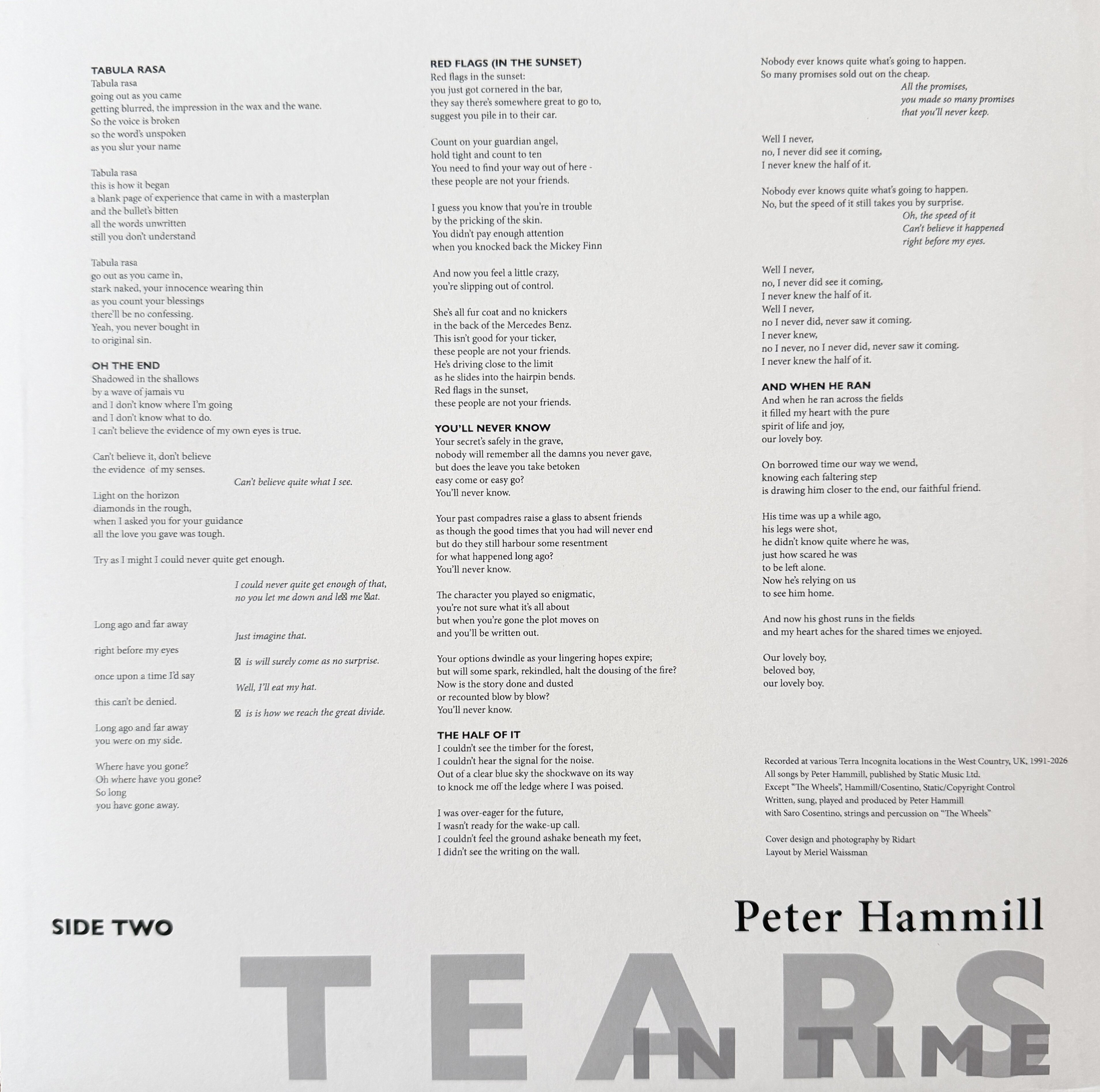
“Tabula Rasa” is a track dating back to the ’90s, retrieved from the archives and presented in a new guise. The song blends a classic singer-songwriter structure with sonorities that recall ambient and vintage electronics, creating an evocative mix. The lyric explores the utopian desire to make a “tabula rasa”, to erase past mistakes and start over, an aspiration that clashes with reality: our history cannot be erased, and lived experiences keep shaping the present. The atmosphere is unsettling, with synths and dissonant guitars, almost disturbing, basses that are at times dark and at times less so…
“Oh The End” is an acoustic ballad of extraordinary intensity, marked by a disarming simplicity. The only elements present are the acoustic guitar, silence, and the singer’s voice. The lyric is a confessional piece that tackles, without mincing words, the theme of mortality, the end of all things, and the serene acceptance of separation. Here the melody returns and the voice is extraordinary and theatrical, moving from falsetto to his famed depth.
In “Red Flags (In The Sunset)”, Hammill lets his abrasive rock soul be heard again. The piece is driven by a distorted, edgy electric-guitar riff, accompanied by a dramatic vocal performance. The lyric is an ironic, angry attack on danger signs, the so-called “red flags”, which humanity and individuals happily ignore as they head toward their own sunset. It starts with an electric guitar and a firm rock tempo, with the bass in a wonderful figure. Here we’ve left psychological prog behind and move toward a more confident, gripping sound. The dissonances remain; offbeats arrive, and the dialogue of two guitars—one rhythm and one lead—intertwining. Then the keyboards come in a hypnotic sequence, but it’s only an interlude. The chorus is very good.
“You’ll Never Know” is a dreamy track with arpeggiated guitar and rarefied atmospheres that highlight Hammill’s more fragile side. The lyric explores deep incommunicability, speaking of the secrets and intimate truths we will always carry with us, the ones loved ones “will never know” completely. We return to the intimacy of the voice-piano dialogue, enriched by echoing guitars and keyboards filling the spaces. A slow, extremely involving track in which even the pauses are music.
“The Half Of It” is a track with a gothic, experimental, progressive sound. The bass lines are heavy and the industrial post-punk rhythms create strong tension. The lyric reflects on the partial nature of the public perception of an artist or a man, stressing that “you don’t even know half the whole story”. Another intimate track that contains hints of almost smothered explosions in the first part, but which then briefly take shape as rhythmic interludes in a flow of echoing guitars… Hammill’s performance is magnificent.
“And When He Ran” is the album’s epilogue, a track marked by soft piano notes and a sumptuous voice. The piece, spare and without frills, is the most heart-rending and emotional moment on the record. Touching and devastating, the track is dedicated to the loss of his beloved dog. In recalling the joyful moments spent running together, Hammill captures the essence of total loss, but also the purity of a primal, deep affection. Piano and hinted keyboards, and the great protagonist is the voice of the immense Hammill. A piece made of silences that are decisive in the track’s dynamics.
It’s a record that demands time and patience—challenging and dark—and needs repeated listens to be fully appreciated. Once past the initial hurdle, however, it reveals itself as a work of great emotional impact. The melodies of Tears in Time are incisive and memorable, with tracks like Heavy Weather or So Much Water sticking in your mind right away thanks to their effectiveness.
When I listen to Hammill, I immediately find myself looking up the lyrics and trying to understand their meaning. I believe it’s impossible to fully appreciate his music without knowing the messages he intends to convey. This album is an extraordinary work that only confirms Peter Hammill’s greatness. His career has never dipped; on the contrary, it keeps growing. It’s a key album in his discography, one of his most vital and memorable solo works of the last twenty years.
My Version
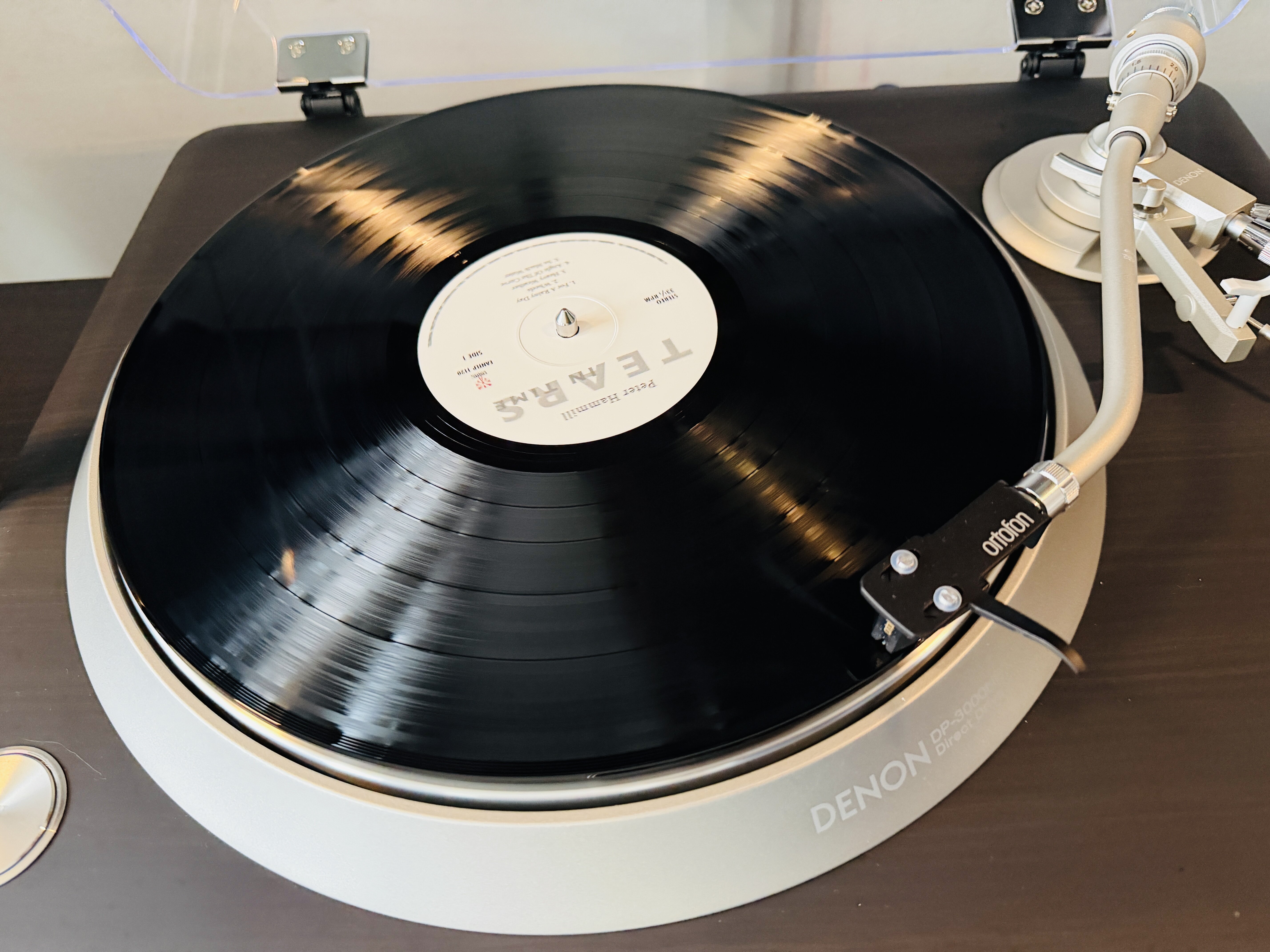
Label: Esoteric Antenna – EANTLP 1120
Format: Vinyl, LP, Album, Stereo
Country: Europe
Release: 2026
Tracklist
1. For A Rainy Day (6:18)
2. The Wheels (5:32)
3. Heavy Weather (4:23)
4. Angle Of The Curve (3:36)
5. So Much Water (3:33)
6. Tabula Rasa (3:45)
7. Oh The End (3:20)
8. Red Flags (In The Sunset) (3:12)
9. You'll Never Know (4:12)
10. The Half Of It (5:17)
11. And When He Ran (2:34)
Lineup
Peter Hammill – Everything (Vocals, piano, keyboards, synthesizers, acoustic guitar, electric guitar, bass, drum programming and samples).