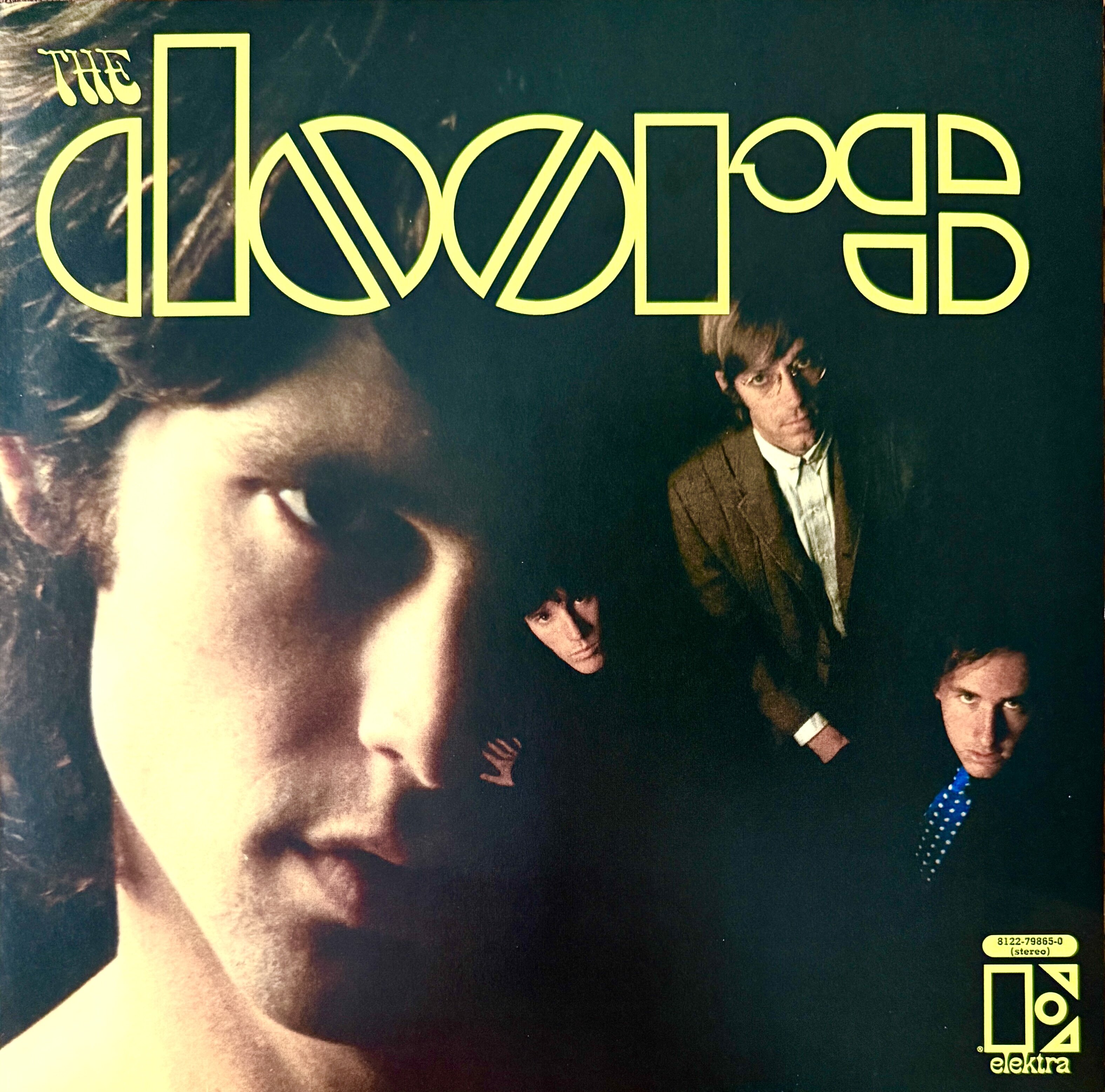
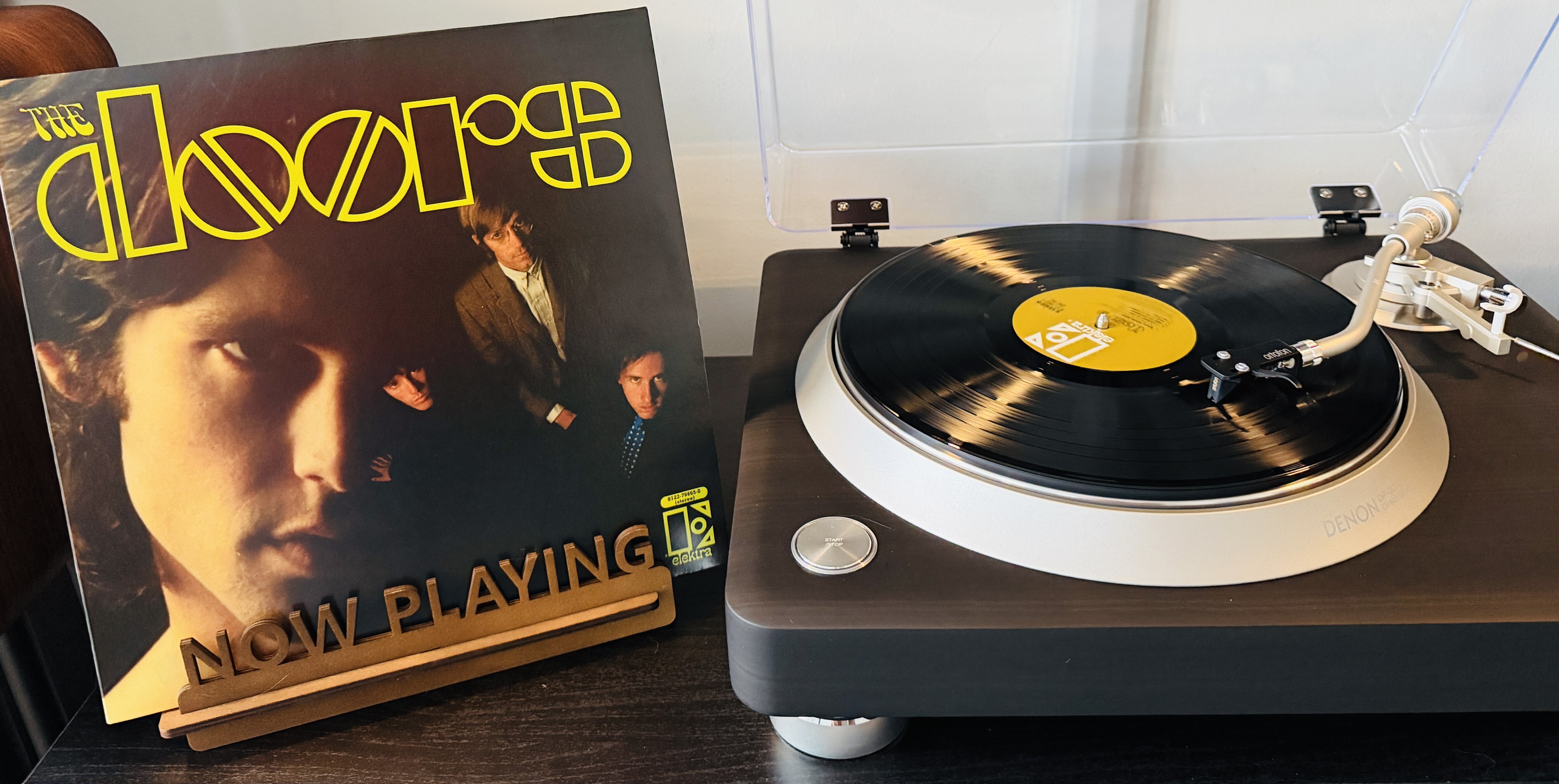
Not Only Prog: The Doors, self-titled debut album, from 1967.
The self-titled album by The Doors, simply titled “The Doors”, is their legendary debut record, released on January 4, 1967 by Elektra Records. It’s a rock milestone, able to blend in a unique way psychedelic rock, blues, and visionary poetry.
The story of this album is a mix of chance encounters, wild nights in Los Angeles clubs, and brilliant insights that, in just a few months, turned four unknown guys into generational icons.
It’s the summer of ’65, and the beach at Venice Beach is a riot of sun, sea, and people having fun. Two UCLA film students, Jim Morrison and Ray Manzarek, run into each other by chance, as often happens in these magical places. Jim, with an enigmatic smile, tells Ray he’s got songs swirling in his head and sings him the first lines of “Moonlight Drive”. Ray, struck by the power and poetry of the lyrics, doesn’t think twice and immediately suggests they start a band.
They’re soon joined by John Densmore, a drummer with overwhelming energy, and Robby Krieger, a guitarist who can move from jazz to flamenco with disarming ease. All four come from a transcendental meditation background, which perhaps explains that special connection and such explosive creativity. The perfect recipe for a band destined to make history.
In 1966, the Doors are an up-and-coming band and land a steady residency as the “house band” at the legendary Whisky a Go Go on the Sunset Strip, one of Los Angeles’ hottest clubs. It’s here that the band sharpens its hypnotic, theatrical sound, playing night after night and stretching songs with instrumental improvisations to fill the evenings. It’s in this setting that songs like “Light My Fire” and “The End” take their final shape, becoming true masterpieces.
But then August 1966 arrives, and the band is abruptly fired by the club owner. During a performance of “The End”, Jim Morrison, under the influence of psychedelic substances, improvises for the first time the famous and controversial Oedipal spoken section. The audience is left speechless, but in the crowd there’s Jac Holzman, founder of Elektra Records, who immediately senses the Doors’ immense potential and decides to sign them. And so, from an unexpected firing, one of the most iconic bands in music history is born.
In just six days, the Doors record an album that will become legend. Leading them are producer Paul A. Rothchild and sound engineer Bruce Botnick. The atmosphere is electric, and the sessions capture the band’s live energy perfectly.
Many tracks are cut in a single take with very few overdubs. A direct, spontaneous approach that perfectly reflects the group’s spirit. And then there’s “The End”, an epic piece recorded completely live in the studio, in the dark, lit only by a candle. Morrison, in a state of shamanic trance, leads the band on an intense, gripping musical journey. Botnick would later recall that, at the end of the recording, no one in the studio could speak because of the intensity of the moment.
The Doors, at the time, didn’t have a permanent bassist. Manzarek played the bass lines with his left hand on a Fender Rhodes Piano Bass. To give the vinyl sound more body, session player Larry Knechtel was brought into the studio, doubling some bass lines. A touch that helped create the Doors’ unique sound.
The album came out on January 4, 1967. At first, sales weren’t great, especially with the first single, “Break On Through”. But then, in May, Elektra had a brilliant idea: release a shorter version of “Light My Fire” for radio, without the long keyboard and guitar solos. The single became No. 1 on the Billboard chart. That made the whole album a worldwide success, cementing the Doors as one of rock’s most important bands.
The story of this album is also the story of the censorship that immediately closed in around it. Jim Morrison’s provocative lyrics and the band’s rebellious attitude clashed with the conservative norms of 1960s America.
Here are some of the most striking moments tied to this record:
During the sessions, Elektra Records asked the band to make a few lyric changes to avoid trouble with radio stations and stores.
In “Break On Through (To the Other Side)”, the line “She gets high” was altered to avoid references to drug use. The original word returned in remastered editions and digital mixes from 1999.
In “The End”, the word “Fuck” in the spoken section was made almost imperceptible to keep the album from being pulled.
On September 17, 1967, The Doors were invited to perform “Light My Fire” on The Ed Sullivan Show, America’s biggest TV program.
Shortly before going live, the producers asked Morrison to change the line “Girl, we couldn’t get much higher” to “Girl, we couldn’t get much better”, because the word “higher” was seen as a reference to drugs.
The band pretended to agree so the performance wouldn’t be canceled. But during the live broadcast, in front of millions of Americans, Jim Morrison sang the original lyric, punching the word “higher” and staring straight into the camera.
Backstage, Ed Sullivan was furious and refused to shake the band’s hand. A producer went to the Doors’ dressing room saying: “Mr. Sullivan wanted you for six more shows, but you’ll never play this show again.” Morrison, calm, replied: “Hey man, we just did the Ed Sullivan Show.”
Beyond lyric censorship, “Light My Fire” also faced a kind of commercial censorship. The original album version ran over 7 minutes—an eternity for radio at the time, which mostly played pop singles of at most 3 minutes. To get the song aired, Elektra was forced to cut the middle section, completely removing Ray Manzarek’s organ solo and Robby Krieger’s guitar solo. Even though the band protested the gutting of their song, it was precisely this shorter version that took the Doors to the top of the charts.
The story behind “Light My Fire” is truly incredible, especially considering it was the very first song Robby Krieger ever wrote. Up to the summer of 1966, Jim Morrison was the only writer of the Doors’ lyrics and music. But Morrison realized they didn’t have enough songs for club nights, and writing everything alone was getting a bit heavy. During a rehearsal, he told the others: “Hey, try writing something too, we need more songs!”
Krieger took the invitation seriously and composed “Light My Fire” with some truly brilliant ideas. Back home, he decided to write something about one of the four elements: earth, air, water, or fire. He chose fire because he was fascinated by the contrast between destruction and passion.
Musically, he wanted a piece that sounded rock but with a complex structure. So he used minor and major chords (especially A minor and F-sharp minor), an unusual combination for the era’s pop-rock that gave the song that hypnotic, suspended, melancholy sound.
Krieger wasn’t a classic rock guitarist. He played classical guitar and flamenco, styles he played without a pick (fingerpicking). And he was a huge jazz fan. For the middle section of “Light My Fire”, he drew inspiration from John Coltrane’s jazz version of “My Favorite Things”. He wanted to create a musical base that would allow lots of improvisation.
This track is a true masterpiece, born from the band members’ collaboration and arrangements. Ray Manzarek created the iconic, surging Vox Continental organ intro, drawing on the rules of classical music, especially Johann Sebastian Bach. Jim Morrison made changes to Krieger’s lyrics, adding the famous central verse, decidedly darker and more poetic (“Our love becomes a funeral pyre…” / Our love becomes a funeral pyre). Finally, John Densmore gave the song a strong rhythmic push, adding a bossa nova accent on the verse and then making the track explode into tight rock during the chorus and solos.
Often labeled psychedelic rock, the album is actually a mix of different genres, making it an almost pioneering work.
While the Summer of Love in 1967 celebrated “Flower Power”, optimism, and bright colors, the Doors’ debut gave us a dark, nocturnal, claustrophobic psychedelia. Tracks like “The End” or “The Crystal Ship” brought a heavy dose of theatricality and shamanism into rock. Their music wasn’t just a series of chords, but a hypnotic sound carpet meant to accompany Jim Morrison’s poetic declamations, turning the rock song into an avant-garde performance or an outright ritual.
The album is a perfect balance between two styles: on one side there are immediate pop-rock songs, perfect for radio (like “Break On Through” or “I Looked At You”), showing a great ability to craft catchy melodies. On the other side there are long improvised suites (like the full versions of “Light My Fire” and “The End”), where the band lets go and abandons the classic verse-chorus structure to explore modal instrumental jams, inspired by John Coltrane’s long jazz improvisations.
I could sum up its style as psychedelic blues with a touch of mystery, supported by jazzy instrumental technique and driven by a literary vision and theatrical aesthetic.
The End, the album’s final track, is a true masterpiece, one of rock’s highest peaks. At 11 minutes and 41 seconds, it’s not a simple song, but a work of art that blends psychedelia, avant-garde theater, philosophy, and shamanism.
Musically, The End has a circular, hypnotic structure. Robby Krieger draws on Indian classical music (ragas) and Ravi Shankar’s style, instead of classic Western chord progressions. Krieger’s guitar and Manzarek’s organ create a continuous sound bed, over which a slow, dramatic gait unfolds. John Densmore’s drums don’t simply keep time, but follow Morrison’s words like in a tribal ritual, building in intensity up to the final explosion.
The lyrics of The End began as a simple farewell song from Morrison to a girlfriend (“This is the end, beautiful friend…”). But night after night on the Whisky a Go Go stage, the piece grew with ever more complex poetic improvisations, until it touched universal themes like death, spiritual journey, and myth. The central section contains the famous recitation inspired by Sophocles’ tragedy Oedipus Rex (“Father? Yes son. I want to kill you. Mother? I want to… fuck you”). With these lines, Morrison staged the psychoanalytic drama of breaking free from family bonds, a primal scream that scandalized puritan America at the time and led to the band being fired from the club.
The recording of The End, which took place at Sunset Sound Studios in Hollywood in August 1966, is one of the most mythologized and insane moments in rock history. It wasn’t a normal recording session, but a full-blown musical séance under extreme psychological tension.
Producer Paul A. Rothchild and sound engineer Bruce Botnick immediately understood that The End couldn’t be recorded in pieces or under the studio’s artificial lights. To capture the track’s ritual nature, they decided to turn off all the lights at Sunset Sound.
The studio was lit only by a single candle burning near Jim Morrison. The band began playing completely live, in the dark, improvising in the shadows. Morrison entered a true shamanic trance, moving and whispering into the microphone. The band followed him with eyes closed, hypnotized by the sonic flow.
Morrison had shown up at the studio under the effect of a massive dose of LSD. During the more than 11 minutes of recording, the atmosphere became so thick and unsettling that sound engineer Bruce Botnick would later say he turned off the lights in the control room and stayed perfectly still: "It was an out-of-body experience. No one spoke. When the song ended, the emotion in the room was so violent that we all stayed silent for several minutes. We had chills".
The track we hear today on the album is exactly the second take (take 2) from that night, recorded in one breath and with no later editing.
If the official session ended with unreal magic, the night took a decidedly wilder turn. Once the recording was done, the band and technicians left the studio around midnight. Morrison, still completely altered by acid and gripped by a mystical delirium, decided to return to Sunset Sound alone in the middle of the night.
He managed to sneak in or convince the night guard.
In the grip of visions, he grabbed a fire extinguisher and started spraying chemical foam everywhere, covering the expensive mixing consoles, microphones, and musical instruments.
Not satisfied, he stripped completely and began dancing naked in the studio, convinced he was officiating a fire purification ritual.
The next morning, the studio owner and producer Paul Rothchild found the place wrecked and thousands of dollars in damage. Rothchild, furious, called Morrison, who remembered absolutely nothing of what had happened. Despite the anger over the disaster, when Rothchild listened back to the tape recorded just hours before the devastation, he realized they had an absolute masterpiece on their hands and decided to forgive the singer.
That crazy night forever sealed the Doors’ myth.
Beyond the two giants Light My Fire and The End, The Doors’ debut album is a perfect mosaic where every single track helps create that hypnotic, mysterious atmosphere. Here are the other essential cuts on the record.
The Crystal Ship: One of Jim Morrison’s most beautiful and melancholy ballads, dedicated to his first real girlfriend, Mary Werbelow. Crystal ships and goodbye kisses, with Manzarek’s piano and organ creating a suspended atmosphere. Morrison’s voice is at its peak—warm, controlled, perfect.
End of the Night: A psychedelic track that I think is underrated, perhaps the album’s purest. The lyrics are inspired by literature, especially Céline’s novel “Journey to the End of the Night” and the poems of William Blake. Robby Krieger’s slide guitar hisses like a ghost, creating a sense of nocturnal mystery.
Soul Kitchen: A rough, bluesy tribute to a home-cooking restaurant in Venice Beach—Olivia’s—where Morrison spent his days as a homeless guy. A concert classic, the track is built on Manzarek’s killer bass-keyboard riff and lyrics that invite you to “warm your soul” before heading back into the cold night.
“Twentieth Century Fox” is an ironic, driving rock song that highlights the band’s more pop, biting side. The lyrics play on the double meaning between the famous Hollywood film studio and the era’s slang, where “fox” meant an attractive girl. It describes a modern, fashionable woman, but cynical and emotionally empty.
Alabama Song (Whiskey Bar): The Doors take on a 1927 opera piece by Bertolt Brecht and Kurt Weill, turning it into a truly unique cabaret-psychedelic experience. To create that surreal fairground or slightly crooked circus sound, Ray Manzarek uses the marxophone, a rather rare stringed instrument in rock, instead of the organ.
Back Door Man: The Doors reinterpret a Willie Dixon blues classic, a legendary piece. If the original was typical Chicago blues, their version electrifies it, making it murky and menacing. It becomes the perfect symbol of Morrison’s wild, sexual swagger on stage.
The album is a true pillar of modern music. Even after decades, it continues to be considered one of the most influential and revolutionary debuts ever. This record didn’t just redefine rock—it also left an indelible mark on aesthetics, pop culture, and the attitude of future generations.
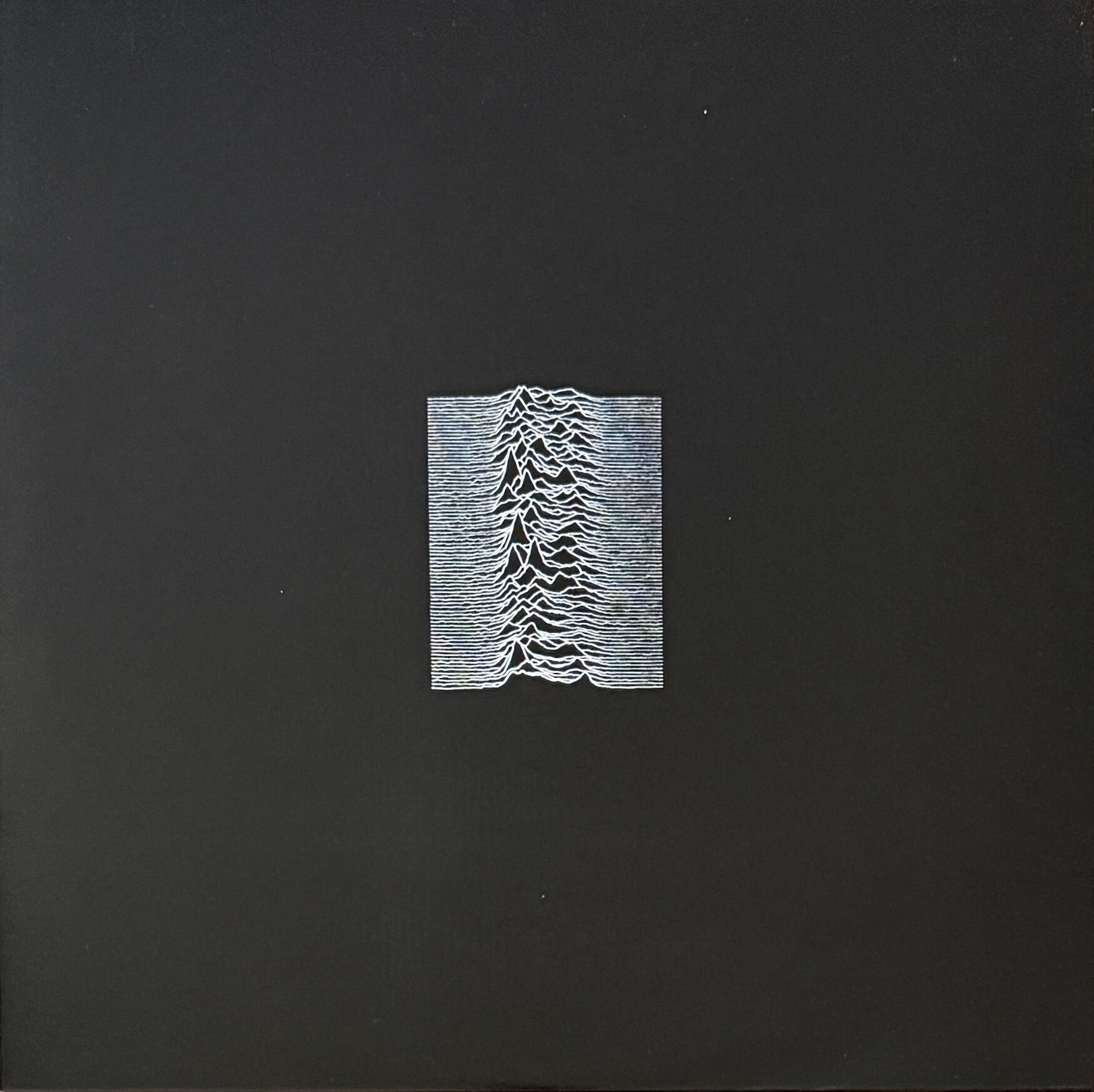
Without this album, genres like gothic rock, post-punk, and the ’70s and ’80s new wave might never have been born. Artists and bands like Joy Division, The Cure, Siouxsie and the Banshees, Echo & the Bunnymen, and Patti Smith have all cited the intense atmospheres of “The End” and Jim Morrison’s baritone, theatrical singing as inspiration.
Jim Morrison, through his tracks, reinvented the figure of the modern frontman, turning him into a kind of shaman, poet, and provocateur. Before him, rock singers were mainly entertainers; after him, the stage became a psychological and political avant-garde theater. His visual style—with the famous leather pants and magnetic stare—and his rebellious attitude influenced countless artists, from Iggy Pop to Michael Hutchence (INXS), all the way to Eddie Vedder (Pearl Jam) and Scott Weiland (Stone Temple Pilots).
This album showed the world that rock music could carry the same intellectual weight as great literature. Morrison normalized references in lyrics to William Blake, Friedrich Nietzsche, Arthur Rimbaud, and Sigmund Freud’s psychoanalysis, turning the pop song into a text to analyze. Also, the members’ film background introduced a “visual” and narrative structure into the songs (just think of the cinematic use of The End in Apocalypse Now), forever changing the way music was composed.
After their debut album, the Doors’ career was a full-throttle ride, packed with intense, unforgettable moments. Sadly, this adventure ended with the tragic death of their frontman, Jim Morrison.
Strange Days (October 1967): Released the same year as the debut, this album continues the psychedelic, slightly mysterious sounds that made the Doors famous. It includes unforgettable tracks like “People Are Strange” and “When the Music’s Over”.
Waiting for the Sun (1968): This album took the Doors to No. 1 for the first time on the U.S. best-selling albums chart, thanks to the success of the pop-rock single “Hello, I Love You”.
The Soft Parade (1969): It was the band’s most controversial record, because they experimented with horns, strings, and orchestral arrangements, orchestrated by Paul Rothchild.
Morrison Hotel (1970): After Morrison’s legal troubles—he had been arrested on stage in Miami in 1969 for indecent acts—the band decided to drop the orchestrations and return to a more visceral, rough, powerful rock-blues. This album opens with the famous “Roadhouse Blues”.
L.A. Woman (April 1971): This was the sixth and last album recorded with the original lineup. It’s a blues triumph recorded almost entirely in an analog, live way in their private studio. It contains absolute milestones like “Riders on the Storm”, “Love Her Madly”, and the title track “L.A. Woman”.
After finishing the mix for “L.A. Woman”, Jim Morrison, worn out by trials, alcohol, and the pressure of fame, decided to take a break from music and move to Paris in March 1971. He wanted to leave the excesses behind and devote himself to his true passion: poetry.
In Paris, Jim lived in the Marais district with his girlfriend, Pamela Courson. Unfortunately, this break didn’t last long. On the morning of July 3, 1971, Jim was found dead in the bathtub of his apartment. He was only 27 and, sadly, became part of the “27 Club”, along with Jimi Hendrix and Janis Joplin, who died shortly before him.
Jim Morrison’s death is still shrouded in mystery and myth today.
The French medical examiner declared the death an “heart attack” caused by respiratory problems and did not consider an autopsy necessary. This immediately fueled speculation about a possible heroin overdose or an illness that occurred at a famous Paris club (the Rock ’n’ Roll Circus) and was then covered up.
News of his death was kept from the media for six days. Only a very few close friends attended the private burial at the famous Père Lachaise cemetery in Paris, where his grave is still one of the most visited pilgrimage sites in the world.
The album “The Doors” is always in the top 50 of Rolling Stone’s 500 greatest albums of all time, and in 2015 it was added to the National Recording Registry of the U.S. Library of Congress for its immense cultural, historical, and aesthetic value.
Tracks like “Light My Fire” keep racking up hundreds of millions of plays on streaming platforms, proving their music crosses generations, timelessly.
The Doors took early rock ’n’ roll and turned it into a mature, fascinating, immortal art form. And they started doing it with this record. Essential.
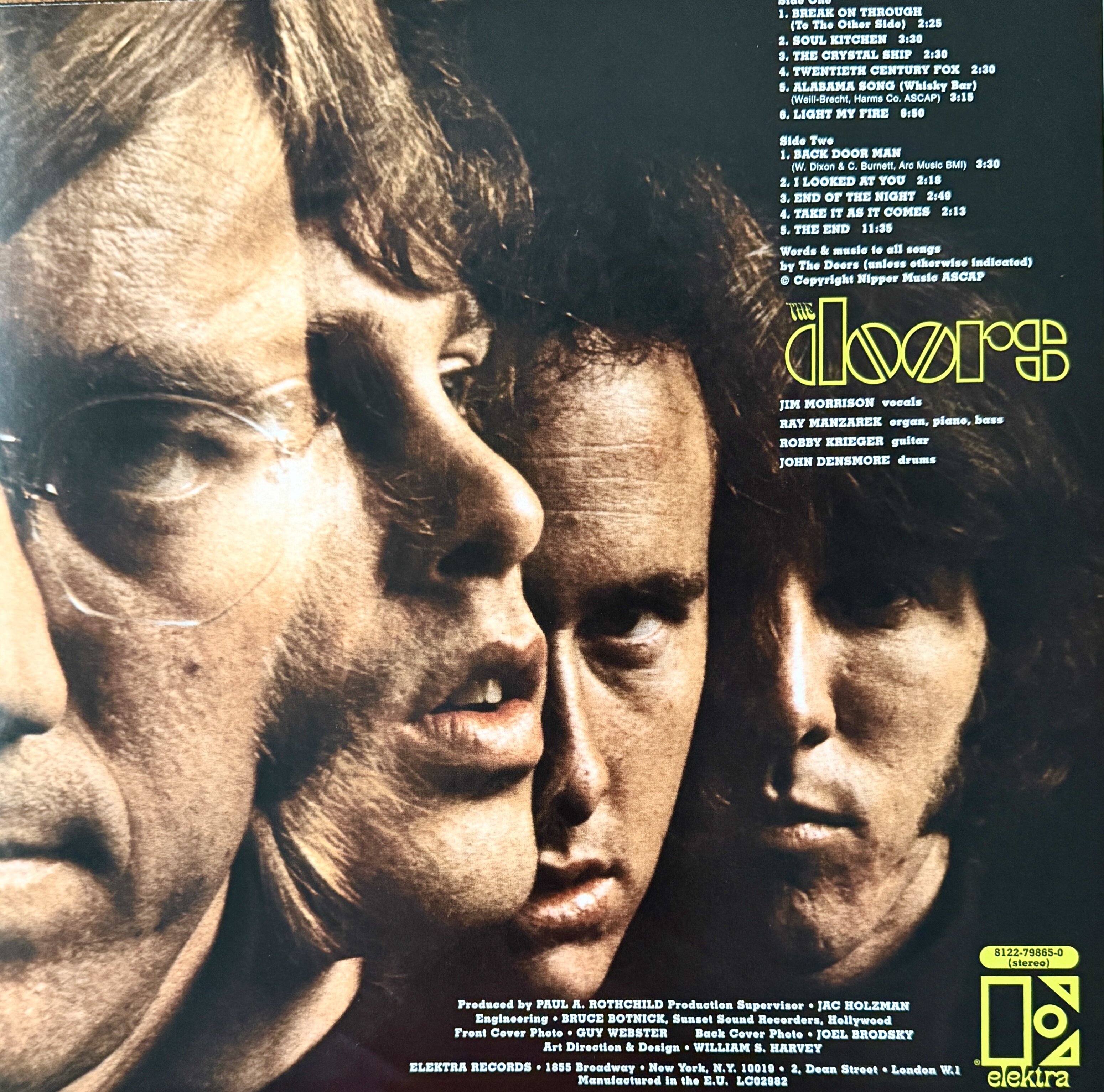
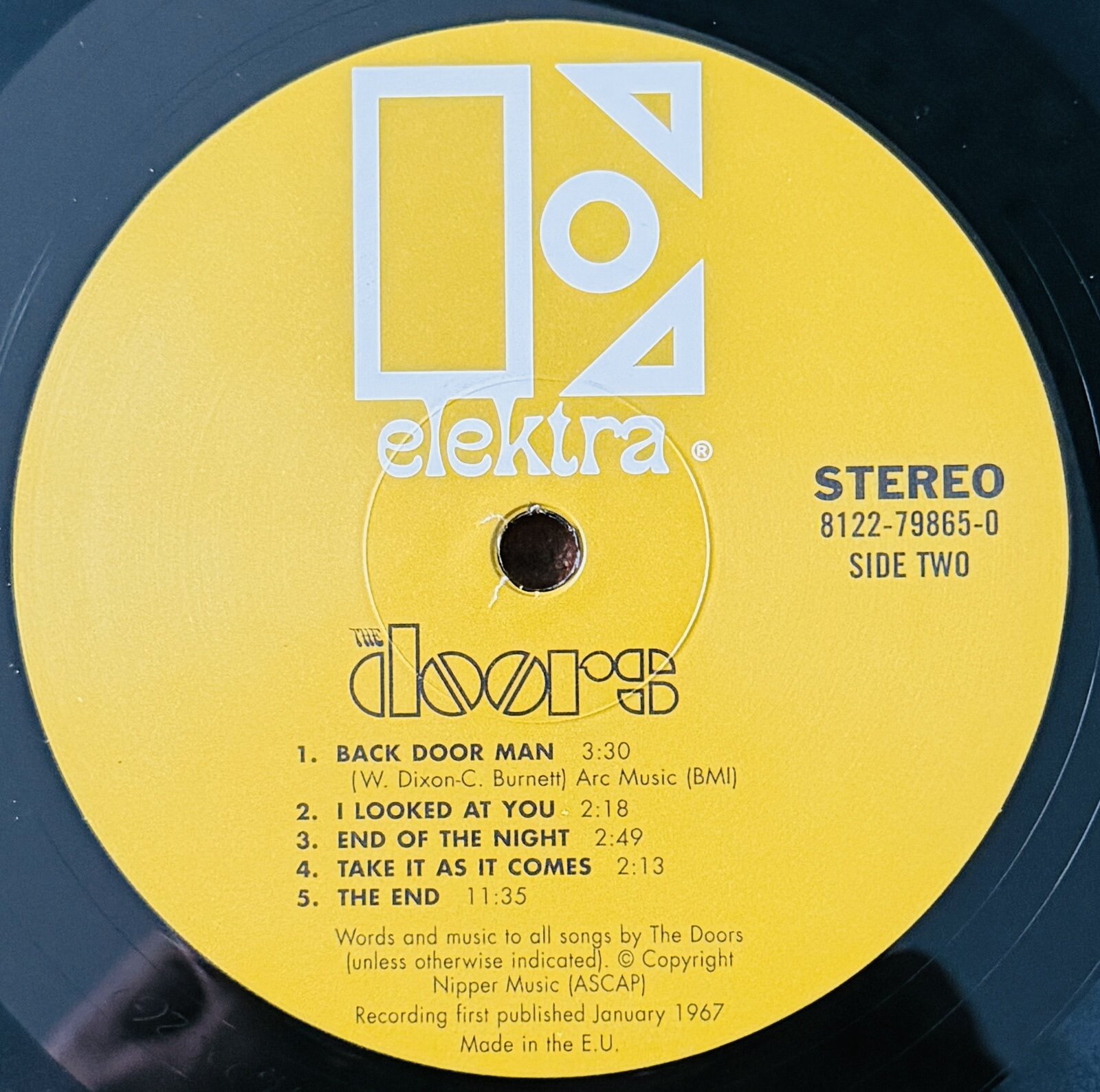
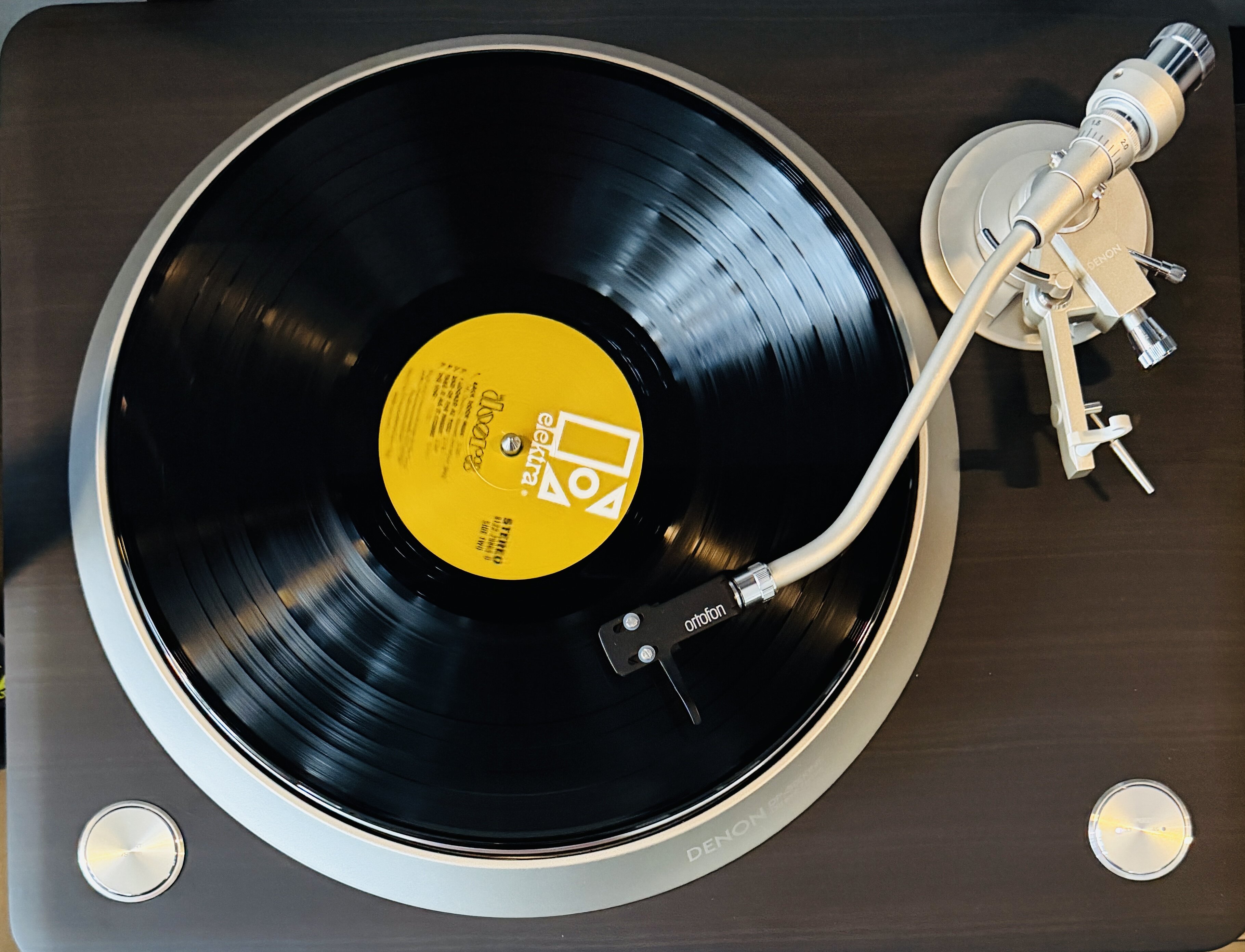
My Copy
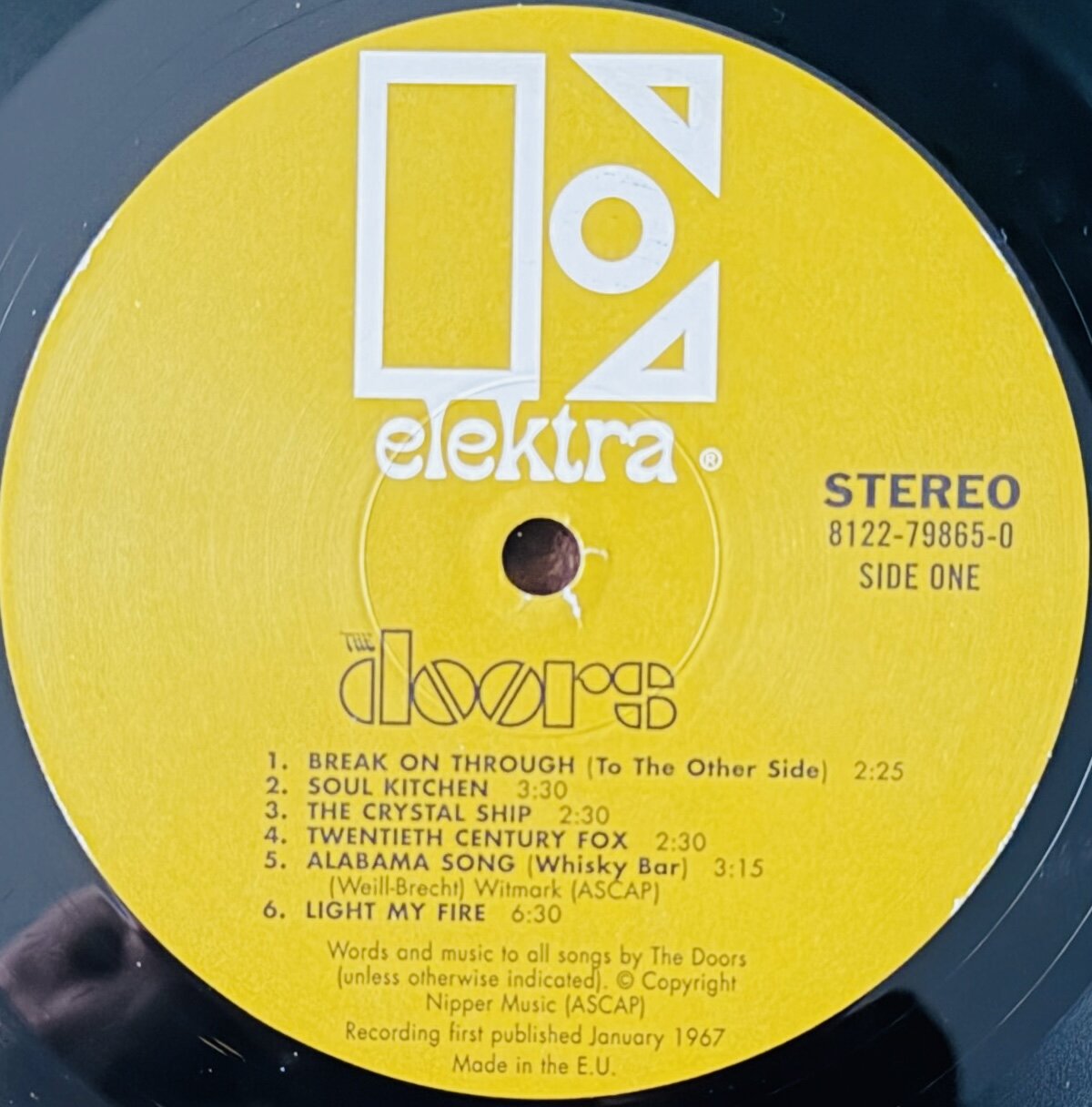
Label: Elektra – 8122-79865-0, Rhino Vinyl – 8122-79865-0
Format: Vinyl, LP, Album, Reissue, Stereo, 180 Gram
Country: Europe
Released: 14 Sep 2009
Tracklist
A1 Break On Through (To The Other Side) 2:25
A2 Soul Kitchen 3:30
A3 The Crystal Ship 2:30
A4 Twentieth Century Fox 2:30
A5 Alabama Song (Whisky Bar) 3:15
A6 Light My Fire 6:50
B1 Back Door Man 3:30
B2 I Looked At You 2:18
B3 End Of The Night 2:49
B4 Take It As It Comes 2:13
B5 The End 11:35
Lineup
Drums – John Densmore
Guitar – Robby Krieger
Organ, Piano, Bass – Ray Manzarek
Vocals – Jim Morrison