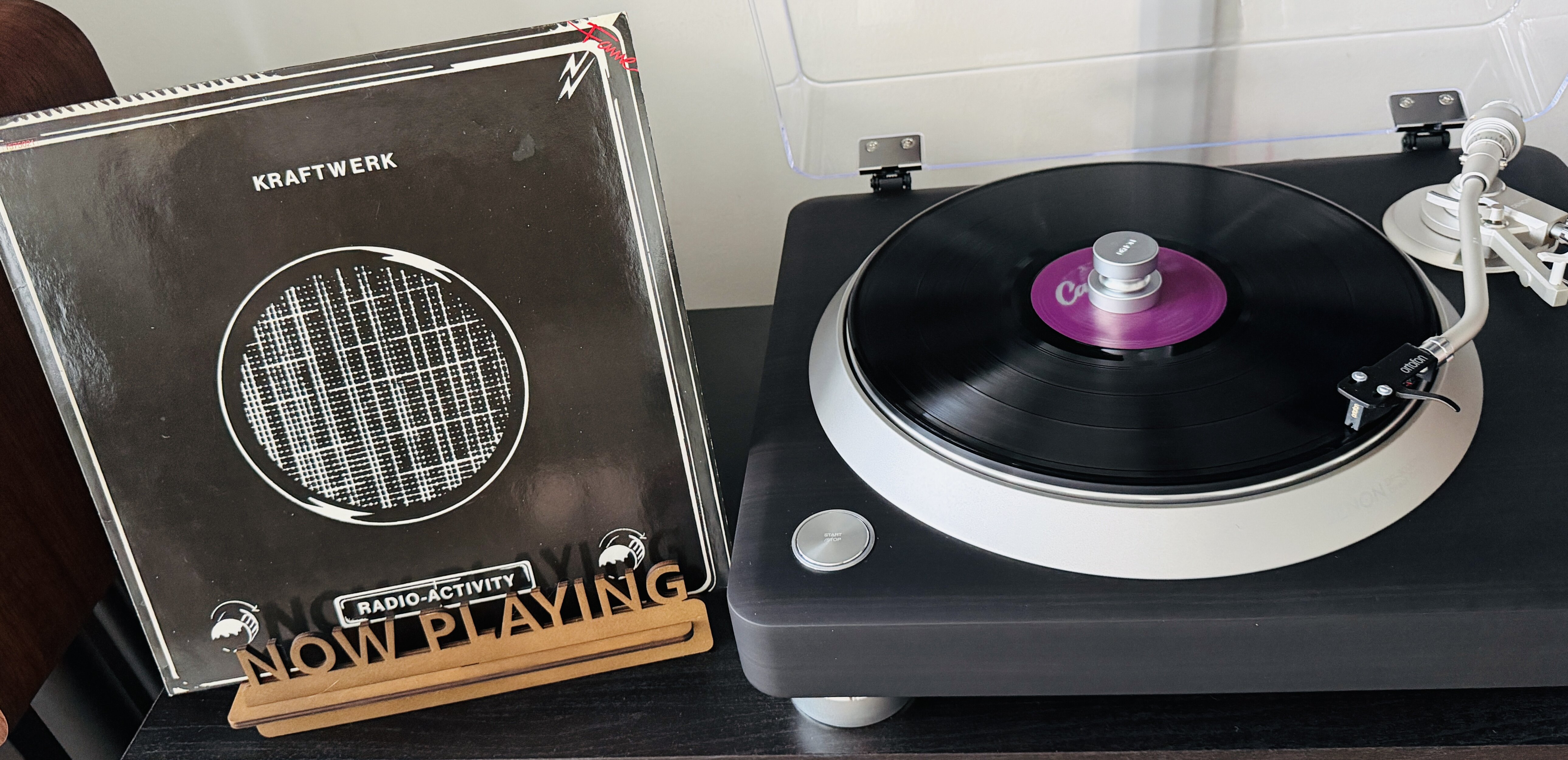
Radio-Activity by Kraftwerk, a 1975 album.
Every time I get ready to listen to a Kraftwerk record, with the splendid vinyl ritual, the first thing that flashes through my mind is: “This is a piece of music history”. But as soon as I put it on the turntable and hear the first notes, the thought changes.
I realize it’s not just a piece of history, but the present, even though more than fifty years have passed since its release. And the more I listen, the more I’m convinced it will probably remain the present in the future too.
Radio-Activity (original German title: Radio-Aktivität) is the fifth studio album by the immense Kraftwerk.
The album is a concept record built around a truly clever bilingual pun. The English title, “Radio-Activity”, refers to radio activity, meaning “activity on the radio”, tied to telecommunications, radio waves, antennas and broadcasts, but also to nuclear radioactivity and atomic decay.
The lyrics, written by Ralf Hütter and Florian Schneider together with painter and lyricist Emil Schult, explore these themes, alternating an almost poetic take on technology with unsettling shades linked to nuclear energy. Unlike later records, where the band recorded separate versions for foreign markets, this album is bilingual, with songs sung both in English and German within the same track.
For the first time in their career, Kraftwerk launched into a completely new sonic adventure, leaving behind traditional instruments like flute, guitar and acoustic drums. They chose to create their music exclusively with synthesizers, frequency generators, electronic keyboards and primitive samplers. This approach produced an artificial, clean and floating sound, far from the rock and pop of the time.
The album fits perfectly into the German Krautrock vein, within the Kosmische Musik current, but it also introduces a strong Synth-pop component. The tracks are no longer long psychedelic improvisations, as on the early albums, but shorter compositions, with catchy, memorable melodies, while still keeping an experimental soul.
Karl Bartos and Wolfgang Flür played self-built electronic percussion, creating a geometric, hypnotic and robotic pulse that became the band’s trademark. Within the record, pop melody alternates with elements of musique concrète and sound design. Many tracks aren’t proper songs, but short noise and ambient interludes that recreate the sounds of technology, like the ticking of a Geiger counter, the hiss of shortwave, and distorted voices turned into robotic sounds by the vocoder.
Despite the use of cold machines, the musical style of Radio-Activity is steeped in a strong melancholic, almost romantic component. Tracks like the title track or Ohm Sweet Ohm use the Vako Orchestron’s synthetic choirs to create airy, solemn and nostalgic arrangements, in perfect balance between technological chill and human emotion.
An album that ranges between pop-electronic songs and more minimalist, reflective moments. At the center of this sonic journey is the title track, “Radioactivity” (Radio-Aktivität), which opens side A with its magnetic energy.
“Radioactivity” is a track that left an indelible mark on the history of electronic music. It opens with the hypnotic ticking of a Geiger counter, which gradually turns into a compelling driving beat. Over this base lies a deep, enveloping Minimoog bass line, accompanied by the Vako Orchestron’s solemn chords, evoking the atmosphere of a Gothic cathedral. Ralf Hütter’s voice, filtered through the vocoder, intones the words “Radioactivity / Is in the air for you and me”, playing on the double meaning of radio transmission and radiation. A perfect blend of pop melody and a robotic, futuristic aesthetic.
The album also offers a series of melodic tracks and experimental sound miniatures that enrich the listening experience.
Antenna, a track with an insistent rhythm and a pop flavor. A bouncy synth riff and well-defined electronic percussion create a lively atmosphere. The lyrics enthusiastically describe how an antenna works as it intercepts signals in the air, celebrating the magic of telecommunications.
Airwaves is a bright, rhythmic piece, marked by fast electronic sequences that evoke the journey of radio waves through space. This track surprisingly anticipates the sounds of the later “Trans-Europe Express”.
Ohm Sweet Ohm begins with a slow, almost sacred atmosphere, thanks to the synthetic choirs, then turns into an ever faster, triumphant melody. The title is a nice pun between “Ohm”, the unit of electrical resistance, and the English saying “Home Sweet Home”, meaning “Home sweet home”.
Geiger Counter is not a real song, but a sound-design experiment that reproduces the sound of a radiation detector near a nuclear source.
The Voice of Energy is a short interlude where a robotic voice, altered with the vocoder, speaks in the first person, impersonating energy itself (“I am the voice of energy…”).
News is an ambient, minimal track with a real radio bulletin over a disturbed electronic sound bed. It recreates the atmosphere of tuning in to a shortwave radio station at night.
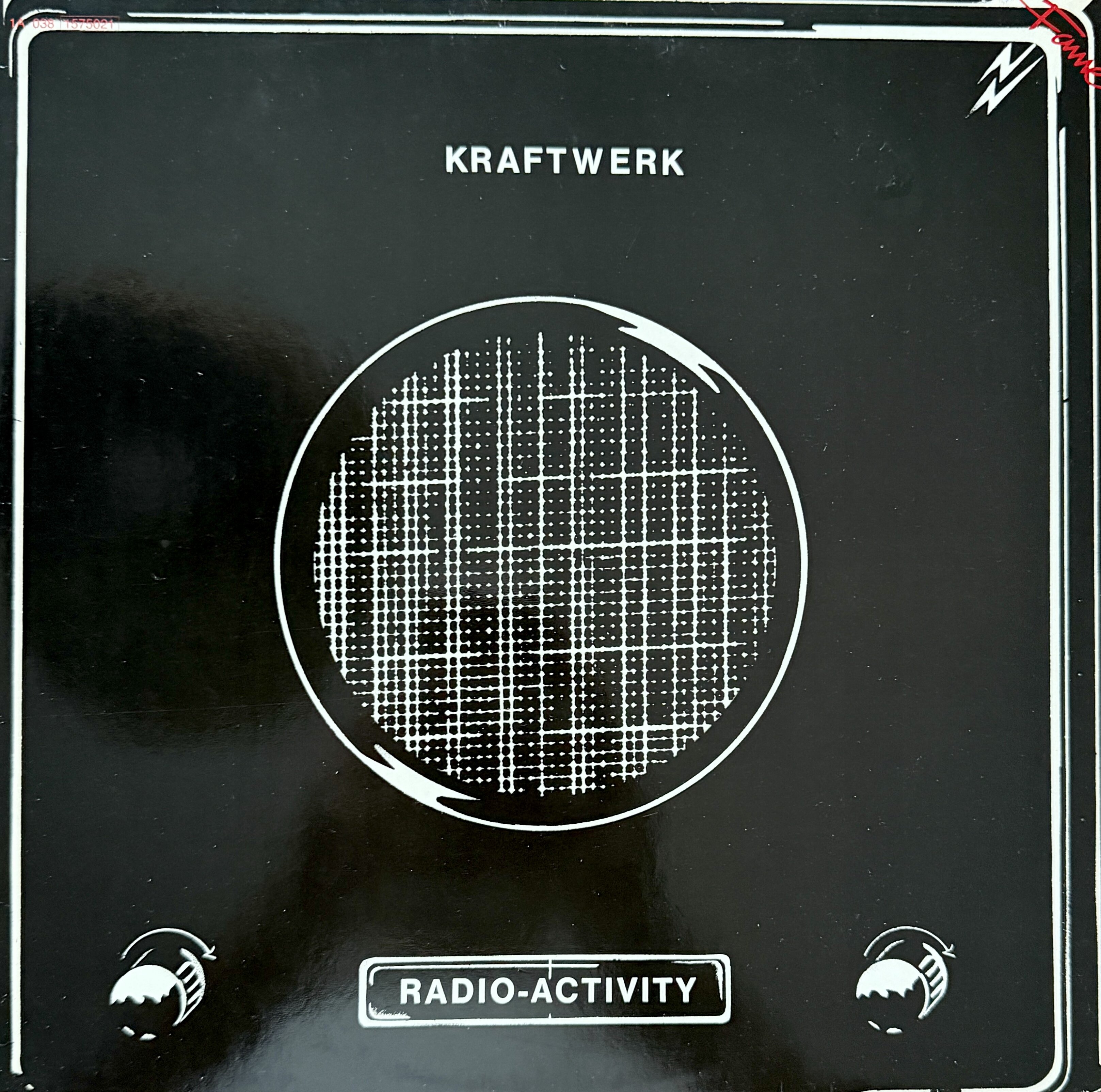
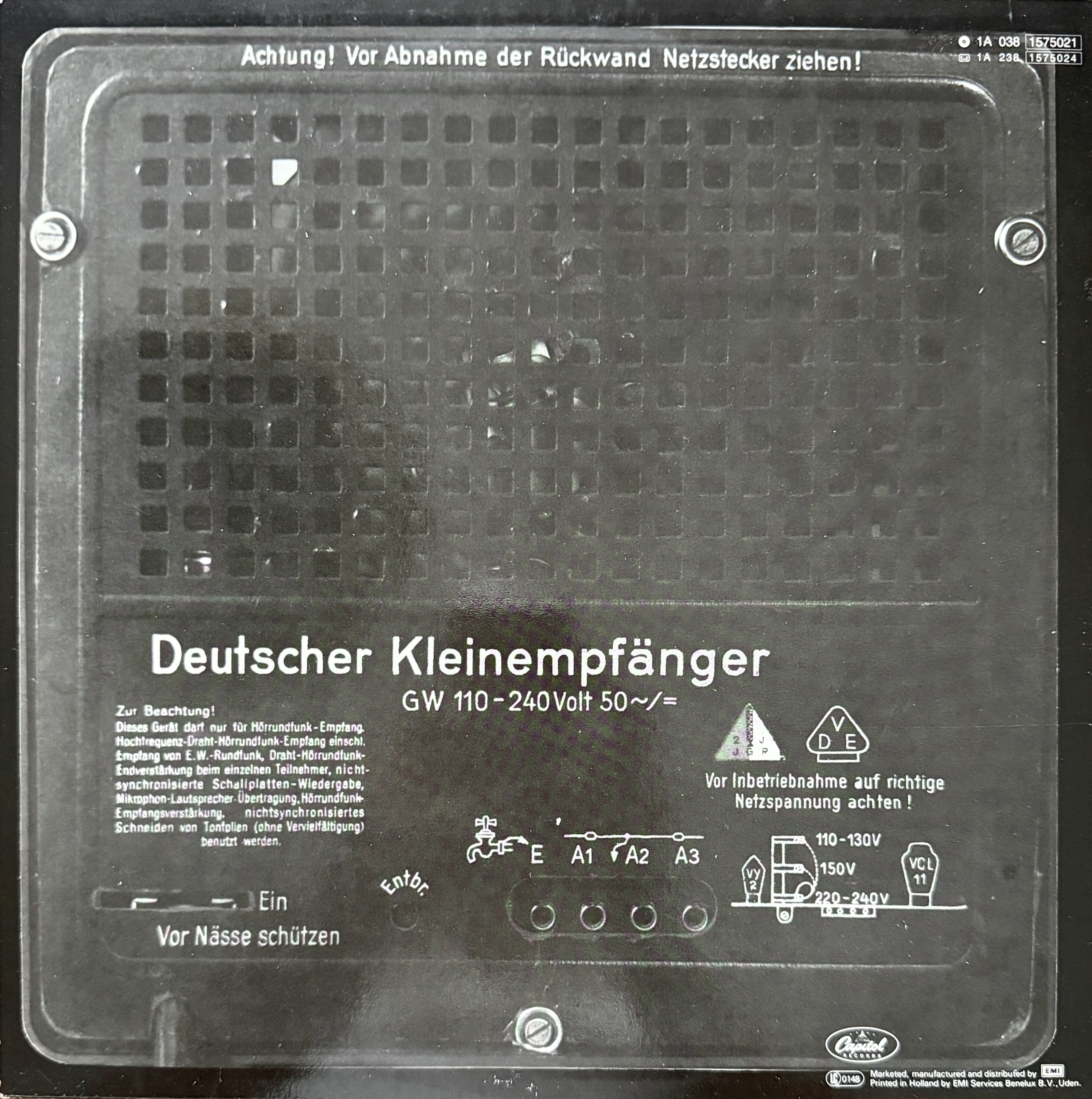
The cover simply shows a close-up silhouette of an old vintage radio. But it’s not just any radio: it’s the Volksempfänger, the “people’s receiver”, a radio set commissioned by the regime in the 1930s to spread State propaganda into the homes of all Germans.
The band chose this image to underline the idea of “activity on the radio” and the mysterious power of mass telecommunications. There’s a touch of typically German irony and detachment: tuning into modern, futuristic frequencies through the symbol of the old State control of the airwaves.
Over the years, this graphic choice sparked debate within the band itself. The percussionist Karl Bartos, for instance, expressed reservations over time about using that symbolism. For this reason, the most recent reissues of the album have dropped the old radio, opting for a completely different design by the famous designer Peter Saville. This new cover is dominated by the iconic yellow-and-black symbol of nuclear radioactivity on a faded background.
If Autobahn (1974) brought them worldwide success, this record marks their definitive move into the future, turning them into a fully electronic band and redefining modern music.
The album is experimental, probably Kraftwerk’s darkest, most layered and most ambient. The gloomy soundscapes, static interference and creative use of noise anticipate genres like Industrial and Ambient.
The real revolution lies in structural innovation: in 1975, Kraftwerk managed to fuse elements of musique concrète (like the ticking of the Geiger counter or radio bulletins) with catchy pop melodies.
Today, even more than at the time of its release, it is rightly considered a conceptual masterpiece.
It’s the record where Kraftwerk became the sound engineers who changed music history forever. Musically excellent, not their masterpiece, but historically of inestimable value.
My Copy
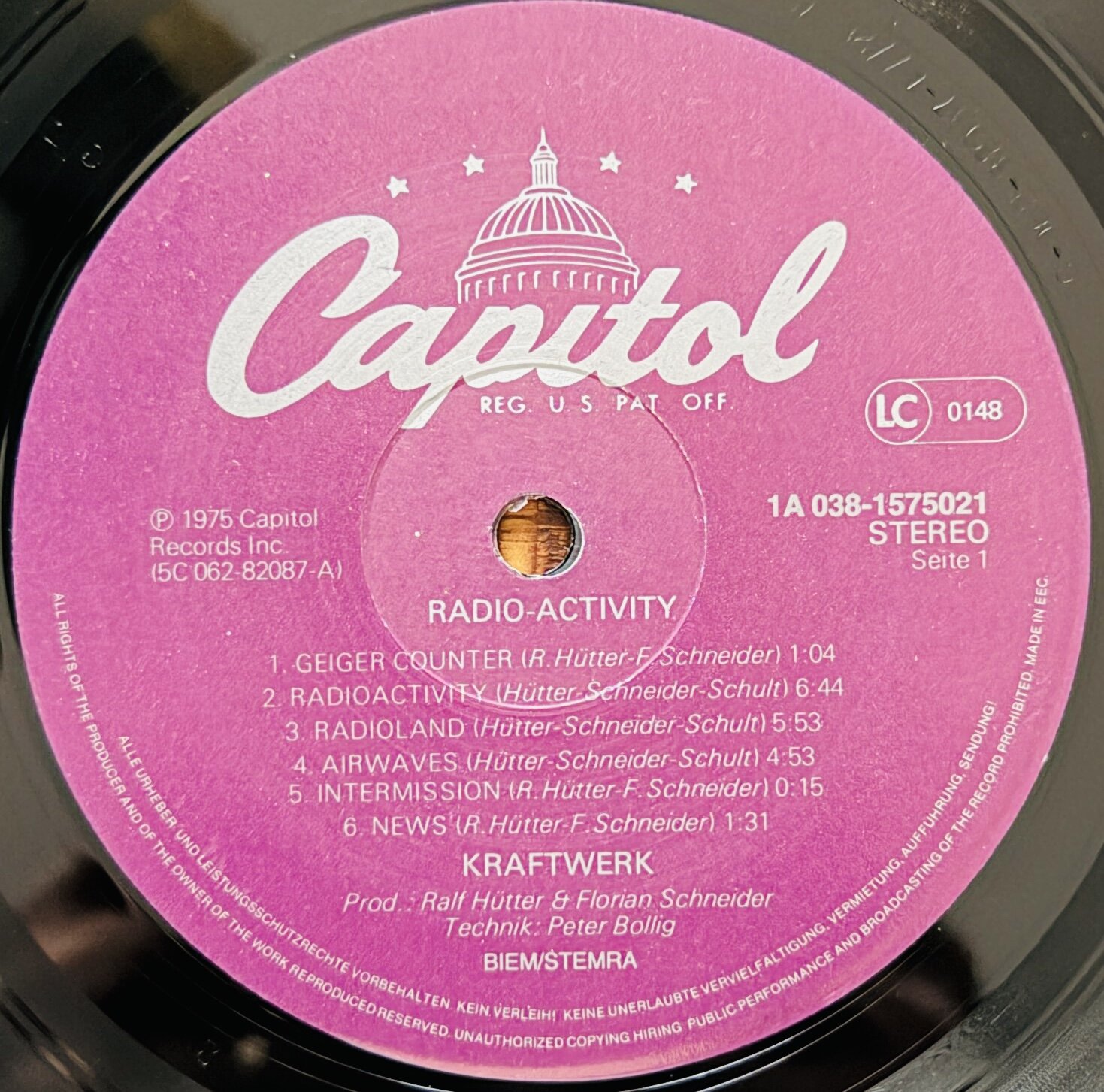
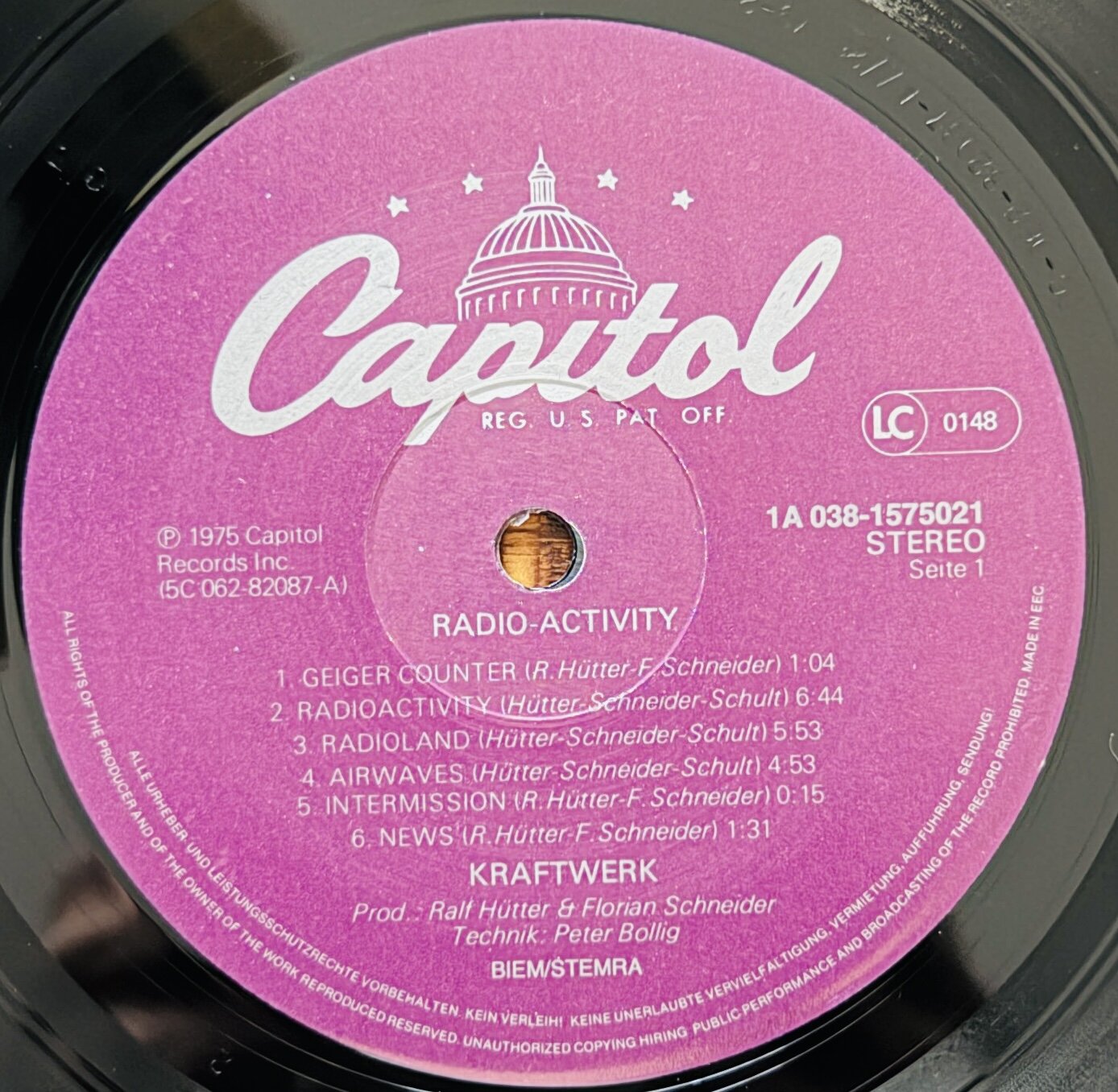
Label: Fame – 1A 038 1575021, Fame – 1A 038-1575021, Fame – 038 1575021, Capitol Records – 1A 038 1575021, Capitol Records – 1A 038-1575021, Capitol Records – 038 1575021
Format: Vinyl, LP, Album, Reissue
Country: Europe
Year: 1983
Tracklist
Side A
1. Geiger Counter (Geigerzähler) – 1:07
2. Radioactivity (Radioaktivität) – 6:41
3. Radioland (Radioland) – 5:51
4. Airwaves (Ätherwellen) – 4:40
5. Intermission (Sendepause) – 0:39
6. News (Nachrichten) – 1:17
Side B
7. The Voice of Energy (Die Stimme der Energie) – 0:55
8. Antenna (Antenne) – 3:42
9. Radio Stars (Radio Sterne) – 3:34
10. Uranium (Uran) – 1:27
11. Transistor (Transistor) – 2:14
12. Ohm Sweet Ohm (Ohm Sweet Ohm) – 5:40
Lineup
Ralf Hütter – Vocals, synthesizers, keyboards, orchestron, drum machine, electronics
Florian Schneider – Vocals, vocoder, synthesizers, frequency generators, electronics
Karl Bartos – Electronic percussion
Wolfgang Flür – Electronic percussion